
Arizona Water Supply in Phoenix: What Every Buyer Needs to Know Before Moving Here
The number one question I get from out-of-state buyers relocating to Phoenix is whether Arizona’s water supply can actually support the growth happening here. It’s a fair question. Headlines about Colorado River shortages make it sound like the desert is drying up. The reality is a lot more reassuring than what you’ve been reading.
Phoenix is not running out of water. Not even close. Here is what the data actually says, and why it matters before you buy.
Why Arizona’s Water Supply Is Stronger Than the Headlines Suggest
Arizona has 1.75 times more water stored than it currently uses. Greater Phoenix alone has 7.1 million acre-feet sitting in reservoirs and underground aquifers right now. Total non-tribal water use in the Phoenix area actually fell 5% between 1985 and 2024, even as the population grew by roughly 3 million people during the same period.
Read that again. Three million more people. Five percent less water used.
That is not an accident. It is the result of decades of intentional policy, conservation infrastructure, and a state that has been planning for water security since before most of these neighborhoods existed. According to the Greater Phoenix Economic Council and the Central Arizona Project, Arizona is using roughly the same amount of water today as it did in the 1950s despite a five-times increase in population and a fifteen-times increase in economic output.
The shift from agricultural land to urban development plays a big role here. Farms use significantly more water than residential subdivisions and commercial buildings. As Greater Phoenix has urbanized and transitioned to a high-tech economy, total water demand has dropped even while the population keeps climbing. That trend is expected to continue.
The 1980 Groundwater Management Act: Arizona’s 100-Year Water Plan
Arizona was the first state in the country to legislate a 100-year water future. The 1980 Groundwater Management Act requires that any new development in an Active Management Area, which includes all of Greater Phoenix, must certify a 100-year assured water supply before a single lot can be subdivided.
This is not a suggestion. It is a legal requirement.
Before a builder breaks ground on a new subdivision, before a developer can sell a lot, they have to prove that the water to support that development exists and is legally secured for the next 100 years. If they cannot prove it, they cannot build it.
This requirement protects everyone. Existing residents are protected because new development cannot legally drain shared water resources. Developers are protected because once water rights are secured, they cannot be pulled mid-project. It is one of the most consumer-friendly pieces of infrastructure law in the country, and most buyers moving to Phoenix from out of state have no idea it exists.
If you are considering moving to the Phoenix metro and weighing whether the water situation should concern you, this law alone should shift your perspective significantly.
Where Phoenix Gets Its Water: Four Sources, Not One
One of the biggest misconceptions about Arizona water supply in Phoenix is that the city runs entirely on the Colorado River. Less than one-third of Greater Phoenix’s annual water usage comes from Colorado River water. The rest comes from a diversified portfolio of four sources.
Groundwater. Underground aquifers across the Valley that have been legally protected and actively recharged for decades. Groundwater levels in Greater Phoenix are generally stable or improving.
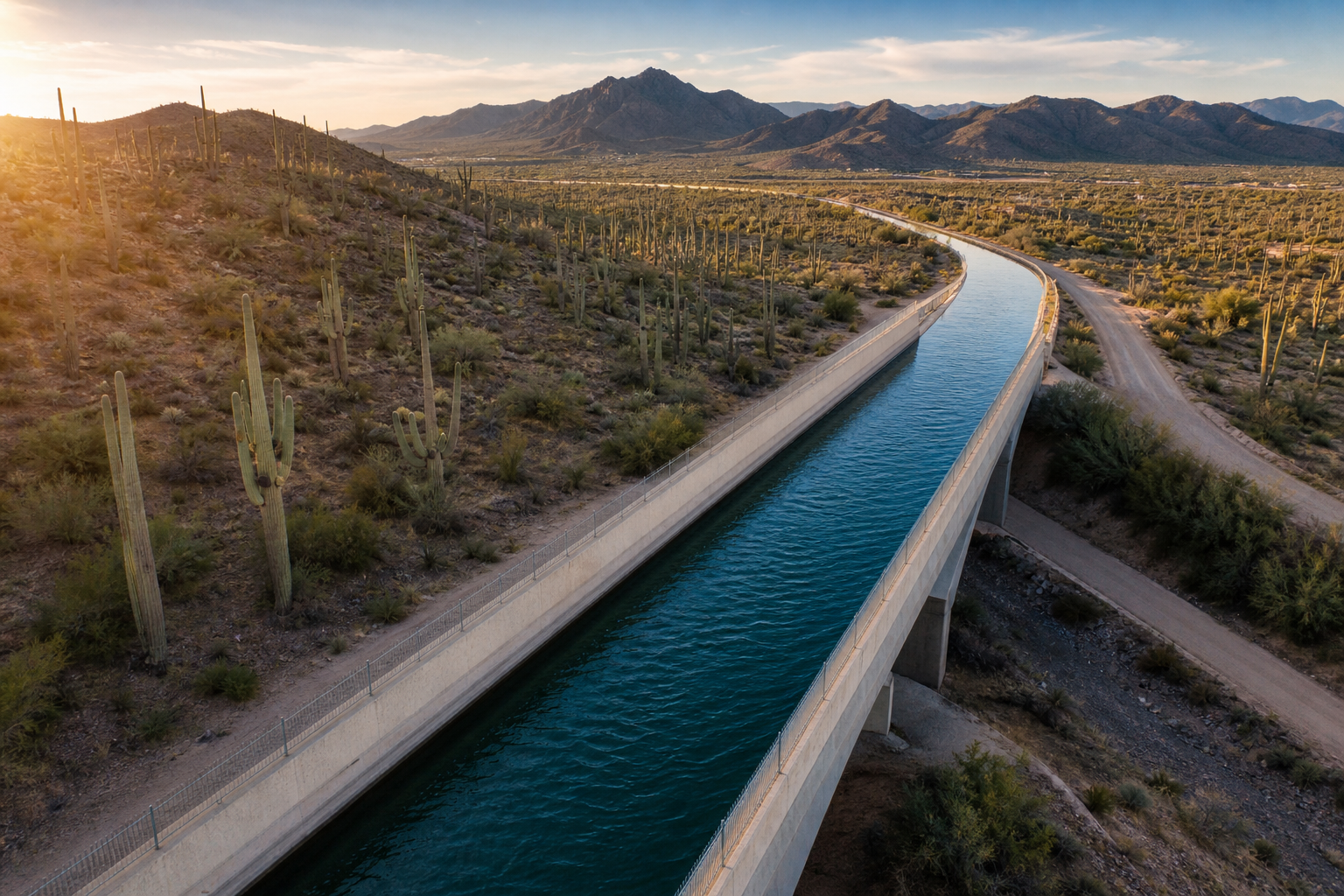
Colorado River water. Transported through Arizona via the Central Arizona Project’s 336-mile aqueduct. Arizona holds a 1.6 million acre-foot annual allocation, though shortage declarations can reduce that figure.
Salt and Verde River water. Managed by the Salt River Project, this is local water that has supplied the Valley since the early 1900s. SRP and CAP announced in November 2025 that they will connect their systems to allow more flexibility in how water moves through the region.
Reclaimed water. More than 89% of water entering Greater Phoenix’s waste stream is reclaimed and reused. Parks, schools, golf courses, aquifer recharge, and power generation all run on reclaimed water. This is among the highest water reuse rates in the country.
The diversification is the point. If one source takes a hit, the others carry the load. This is not a single-pipe city.
What the Colorado River Shortage Actually Means for Phoenix
The Colorado River is under stress. That part is true. Flows have declined, and shortage declarations reduce Arizona’s normal allocation. For buyers and investors, it is worth understanding what that actually means on the ground.
It does not mean Phoenix is running dry.
For decades, Colorado River water and reclaimed water have been pumped underground to recharge aquifers specifically to build a reserve for exactly this scenario. The Groundwater Management Act protects those aquifers from being over-tapped. The underground water bank exists to buffer against shortage periods on the Colorado. That is not a lucky coincidence. It was planned.
Arizona also has a structural advantage that most coastal or flood-prone states do not. The challenge here is moving a defined quantity of water from one place to another, or augmenting existing supplies. Compare that to building levees against rising sea levels, constructing storm surge infrastructure against hurricanes, or engineering floodwater mitigation after billion-dollar disasters. The Arizona water problem is solvable in a way that other states’ environmental challenges are not.
For anyone weighing a relocation and asking whether Arizona is a good long-term bet on livability, the water picture actually makes Phoenix more defensible, not less.
What Arizona Is Doing Right Now to Secure the Future
The state is not sitting still. A few things worth knowing if you are thinking long-term about the Valley.
In 2023, Arizona placed a moratorium on native groundwater use for new developments in fringe areas outside Greater Phoenix that do not already have a 100-year water supply secured. This made national news and spooked some headlines into treating it as a crisis. It was the opposite. It was Arizona protecting existing groundwater stocks from being tapped by sprawl that had not yet earned the right to use them.
Growth continues. It is just being redirected toward alternative and augmented water supplies instead of drawing down protected reserves.
The Water Infrastructure Finance Authority received $400 million in funding for projects that import new water supplies into Arizona. It has already allocated $200 million across 150 conservation projects and is preparing to launch a $96 million loan program for in-state water providers.
Governor Hobbs announced a $60.3 million investment in January 2025 focused on conservation, advanced technology, infrastructure improvements, and water sustainability.
SRP is also evaluating the Verde River Sediment Mitigation Project, which looks at how to restore or expand storage capacity at Horseshoe and Bartlett Dams through sediment removal, dam raising, or new construction.
This is not the behavior of a region managing decline. It is the behavior of a region planning aggressively for continued growth.
What This Means If You Are Buying a Home in Phoenix
If you are researching whether now is a good time to buy a home in Phoenix, water security should actually move you toward yes, not away from it.
Every new subdivision in Greater Phoenix has a legally certified 100-year water supply. The infrastructure is diverse, redundant, and actively managed. The state has more water in reserve than it uses annually. And the regulatory framework requires proof of water access before a single shovel hits the ground.
Buyers coming from the Pacific Northwest, Texas, Florida, or the Southeast are often surprised to learn that Phoenix has more legislative infrastructure protecting long-term water security than most of the places they are moving from. Floods, hurricanes, wildfires, and drought hit everywhere. Phoenix has a 40-year head start on planning for the one that actually matters here.
If you are also thinking about this from an investment standpoint, the water picture supports continued demand in the Valley for the foreseeable future. Population growth, corporate relocations, and infrastructure investment are all flowing toward markets with manageable long-term livability risk. Phoenix clears that bar. If you want to talk through where to invest in the Phoenix metro, I can walk you through what the data looks like right now.
The Bottom Line on Arizona Water Supply in Phoenix
Arizona water supply is not a reason to avoid Phoenix. It might actually be a reason to move here faster than you think.
The state has been planning for this since 1980. The reserves are there. The regulatory framework protects them. And the investment pipeline to augment future supply is already funded and underway. The headlines about the Colorado River are real, but they tell about 30% of the story. The rest of the story is a state that has been managing this challenge for longer than most Americans have been paying attention.
If you are moving to the Phoenix metro or thinking through a purchase in the Valley, I am happy to talk through any of this in plain terms. Call or text me at (602) 935-6959, email Robbie@RJHHomesTeam.com, or visit rjhhomesteam.com.
Robbie Holycross is the founder of RJH Homes and has been working with buyers, sellers, and investors across the Valley for 6 years. He holds a background in finance and economics and carries an active mortgage license (NMLS 2633845), specializing in move-up buyers and real estate investors throughout the greater Phoenix metro.
Phoenix Metro Water Sources: Where It Comes From
| Water Source | % of Supply | Details |
|---|---|---|
| Salt River / Verde River | ~40% | Local surface water stored in reservoirs (Roosevelt, Saguaro, etc.) |
| Colorado River (via CAP Canal) | ~40% | Central Arizona Project delivers water 336 miles from Lake Havasu |
| Groundwater | ~15% | Underground aquifer reserves, regulated by AZ Dept of Water Resources |
| Reclaimed / Recycled Water | ~5% | Treated wastewater used for parks, golf courses, and aquifer recharge |
Sources: Arizona Department of Water Resources, Salt River Project, Central Arizona Project, City of Phoenix Water Services
Frequently Asked Questions About Arizona’s Water Supply
Keep Reading
If you found this helpful, check out these related articles:
- Moving to Phoenix Arizona: Relocation Guide
- Cost of Living in Phoenix AZ
- Arizona Neighborhoods Before Buying
- Is Now a Good Time to Buy in Phoenix?
Is Arizona running out of water?
No — but the headlines make it sound worse than reality.
No — but the headlines make it sound worse than reality. The Phoenix metro has one of the most sophisticated water management systems in the country, with multiple redundant sources, mandatory conservation programs, and underground water banking that stores billions of gallons for future use. The 2023 groundwater restrictions on new development in some unincorporated Maricopa County areas made national news, but those restrictions apply to undeveloped areas outside existing cities — not to established communities in Phoenix, Mesa, Gilbert, Chandler, Scottsdale, or Tempe. Established cities have 100-year Assured Water Supply designations from the Arizona Department of Water Resources.
Will water issues affect my home value in Phoenix?
Water perception affects values more than water reality.
Water perception affects values more than water reality. Homes in cities with 100-year Assured Water Supply designations (Phoenix, Mesa, Scottsdale, Gilbert, Chandler, Tempe, and other established cities) have not seen measurable price impacts from water headlines. However, homes in areas without assured water supply — particularly some unincorporated county areas and newer developments that rely solely on groundwater — may face long-term value risk. When buying, verify that the property is within a city or community with an Assured Water Supply designation. This is a critical due diligence step that most out-of-state buyers don’t know to check.
What is a 100-year Assured Water Supply in Arizona?
Arizona’s Assured Water Supply (AWS) program requires developers within Active Management Areas (AMAs) to demonstrate they have a 100-year water supply before building new homes.
Arizona’s Assured Water Supply (AWS) program requires developers within Active Management Areas (AMAs) to demonstrate they have a 100-year water supply before building new homes. This means established cities like Phoenix, Mesa, Gilbert, and Scottsdale have proven their water portfolio can sustain current and projected demand for the next century. The AWS designation considers surface water rights, Colorado River allocations, groundwater permits, and reclaimed water capacity. It’s one of the strongest water planning frameworks in the western United States and a key reason why the Phoenix metro is better positioned than many people assume.
How does Arizona compare to other states on water?
Arizona is actually better prepared for water challenges than most western states because it started planning earlier.
Arizona is actually better prepared for water challenges than most western states because it started planning earlier. The state’s 1980 Groundwater Management Act was the first of its kind in the nation, and the Central Arizona Project canal (completed in 1993) diversified the state’s water portfolio decades ago. Cities like Las Vegas, Los Angeles, and Denver face similar Colorado River pressures but have less diversified supply portfolios. Arizona also leads in water recycling — Scottsdale’s advanced water treatment facility was the first in the world to turn recycled wastewater into drinking-quality water. The key difference: Arizona treats water scarcity as an engineering problem, not a crisis.
Should water concerns stop me from buying a home in Arizona?
For homes within established cities (Phoenix, Mesa, Gilbert, Chandler, Scottsdale, Tempe, Queen Creek), water should not be a deal-breaker.
For homes within established cities (Phoenix, Mesa, Gilbert, Chandler, Scottsdale, Tempe, Queen Creek), water should not be a deal-breaker. These cities have robust, diversified water portfolios and 100-year Assured Water Supply designations. However, you should:
- Verify the property is within a city with AWS designation — not unincorporated county land
- Check if the community uses a private water company — some have less reliable supply
- Ask about any water-related HOA assessments — some communities have infrastructure upgrade fees
- Consider xeriscaping — low-water landscaping reduces your personal water bill by 30-50%
The bottom line: Arizona’s water situation is manageable and well-managed, but doing your due diligence on the specific property’s water source is smart buying practice.