
How to Increase Your Home Value in Arizona Before Selling
Every week somebody asks me a version of the same question: “What should I fix before I list?” And almost every week, the answer surprises them. Most sellers assume the path to a higher sale price runs through the kitchen. Sometimes it does. More often, the money that actually moves your number is spent outside, on things buyers see in the first eight seconds — and on the boring stuff nobody brags about at a barbecue.
I’m Robbie Holycross, and I sell homes across Maricopa County. This is the honest breakdown of how to increase home value in Arizona before you sell: what pays, what doesn’t, what the desert specifically demands, and how to sequence it so you’re not spending $40,000 to gain $18,000. The Phoenix metro in mid-2026 is a flat, patient market — median sales price sat at $454,990 in July, up just 1.1% year over year, with about 132 days of inventory on the books (Cromford Report data, July 2026). Flat markets don’t reward hope. They reward homes that present better than the one down the street.
The Uncomfortable Truth About Renovation ROI
Zonda’s 38th annual Cost vs. Value Report — the industry standard, built by asking appraisers and listing agents in 150+ markets what completed projects actually add to resale value — found that eight of the top ten highest-ROI projects in the country are exterior replacements, not interior remodels (Zonda, September 2025).
Read that again, because it’s the opposite of what HGTV taught everyone. A garage door you never think about returns more than a gut kitchen you’ll obsess over for four months.
| Project | National avg. cost | Cost recouped | My read for AZ sellers |
|---|---|---|---|
| Garage door replacement | $4,672 | 267.7% | Do it. Huge street-facing impact, sun-faded doors are everywhere here |
| Steel entry door replacement | ~$2,600 | 216% | Do it if yours is chalky or scorched |
| Manufactured stone veneer | ~$11,900 | 208% | Selective — works on plain stucco elevations |
| Fiber-cement siding | $21,485 | 113.7% | Rarely applicable on Valley stucco homes |
| Minor kitchen remodel | $28,458 | 112.9% | Best interior play, but “minor” is the operative word |
| Major upscale kitchen remodel | $160,000+ | 36.6% | Never, right before selling |
The gap between that 112.9% minor kitchen return and the 36.6% luxury gut job is the single most important number in this entire article. Every dollar past “clean, current, and functional” is a dollar you’re spending on yourself, not on your sale price. If you’re staying five more years, remodel for you. If you’re listing in ninety days, remodel for the buyer.
Curb Appeal in the Desert Is a Different Sport
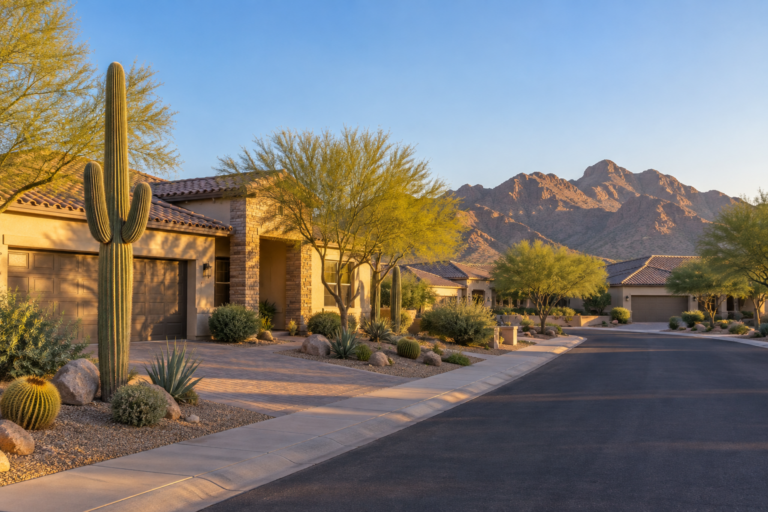
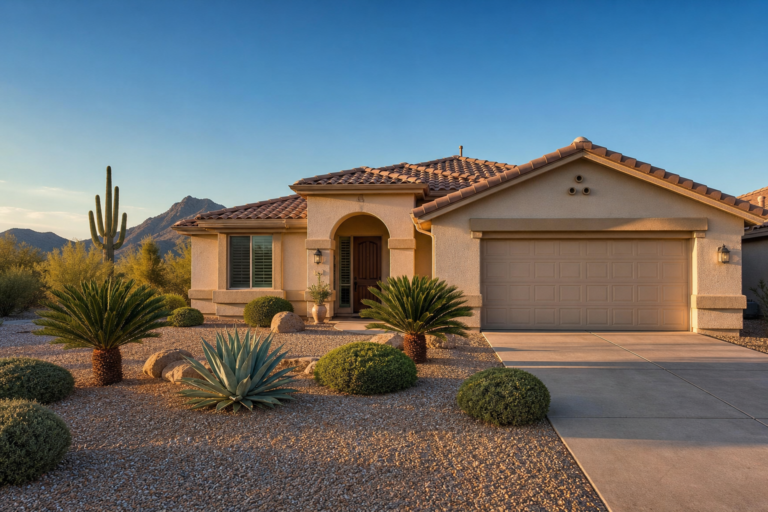
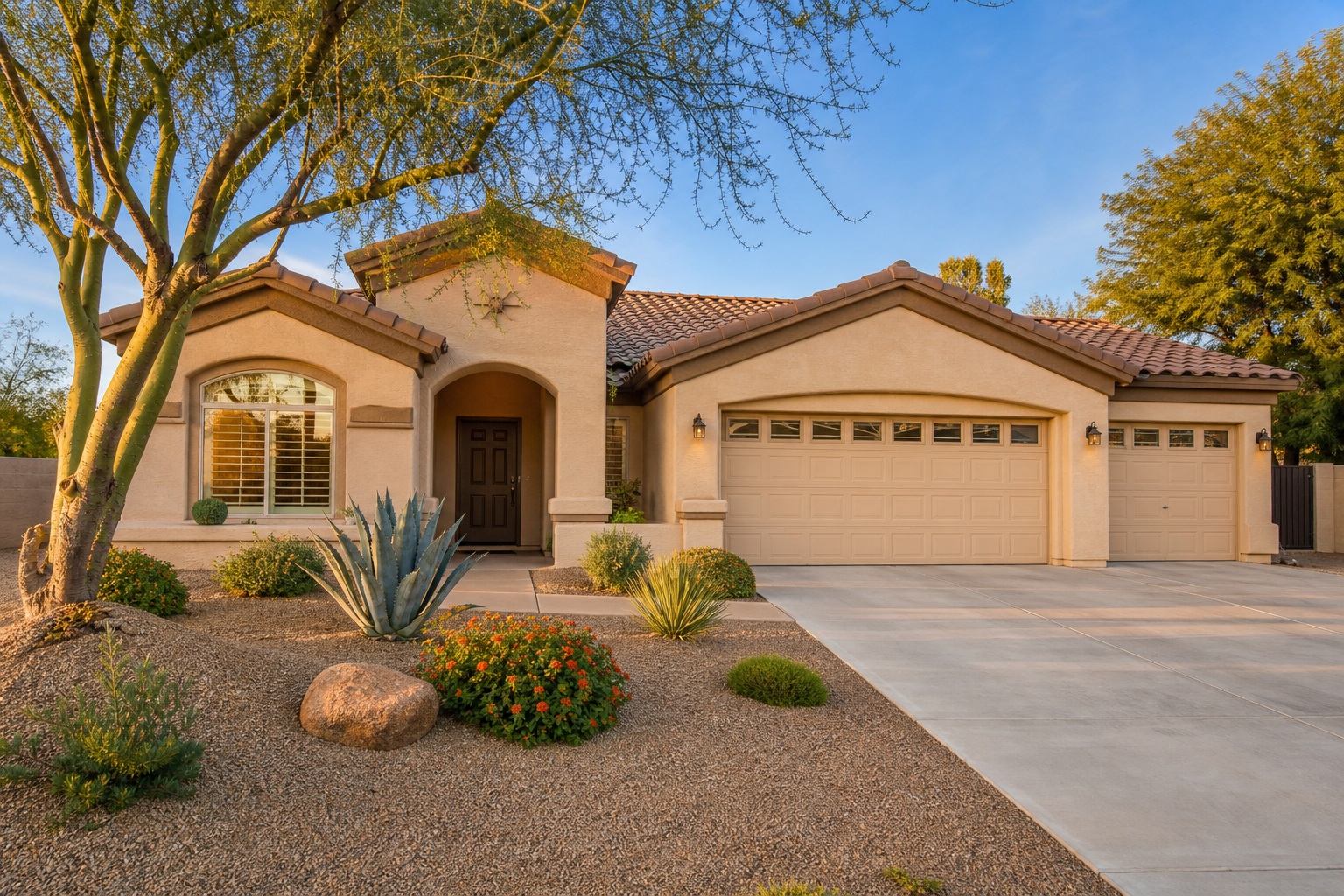
In Ohio, curb appeal means green grass and mulch. Here it means the sun hasn’t beaten your house into submission. Buyers walking up to an Arizona home read three things instantly: is the paint chalky, is the granite faded and weed-shot, and are the plants alive or dead.
The cheapest, highest-leverage front-yard work in the Valley:
- Fresh decomposed granite. A truckload of new DG over a raked, pre-emergent-treated yard makes a tired lot look maintained. It runs roughly $1.50–$4.00 per square foot installed (Phoenix landscaping cost guide, 2026). On a typical front yard that’s a few hundred to a couple thousand dollars and it photographs beautifully.
- Trim the trees, don’t remove them. Mature shade is an asset in a 115° market. Skirt-trimming a mesquite or palo verde runs $200–$600 per tree. Removing it costs more and loses value.
- Replace dead plants, not the whole design. Five healthy agave, lantana, and red yucca at the entry beat a $20,000 redesign.
- Fix the drip system. Buyers test valves. Dead emitters signal deferred maintenance on everything else.
| Desert landscape item | Typical Valley cost (2026) | Pre-listing verdict |
|---|---|---|
| Full xeriscape / desert install | $5–$20 per sq ft | Only if the yard is dirt or dead |
| Decomposed granite ground cover | $1.50–$4.00 per sq ft | Almost always worth it |
| Drip irrigation system | $1,500–$4,500 | Repair, don’t replace |
| Artificial turf | $7–$15 per sq ft | Small back-yard patches only |
| Tree / cactus trimming | $200–$600 per tree | Yes — highest visual return per dollar |
| Paver patio | $14–$28 per sq ft | Skip unless the slab is cracked and ugly |
Exterior paint deserves its own note. Stucco in this climate takes a real beating, and most Valley exteriors need elastomeric coating to survive summer. A 2,200-square-foot Chandler or Gilbert home runs about $5,800–$12,200 for exterior paint (Phoenix painting cost data, 2026). That’s a big check. My rule: if the paint is chalky enough to come off on your hand, or if there are two different colors from past patch jobs, paint it. If it just looks a little tired, wash it and spend the money elsewhere.
The Kitchen: Do Less Than You Think
A “minor kitchen remodel” in the Zonda definition is not new cabinets. It’s refacing or repainting existing cabinet boxes, new hardware, a new countertop, a new sink and faucet, updated lighting, and one appliance swap if something is visibly ancient. That is the version that returns 112.9%. The one that returns 36.6% is the one where you move plumbing.
What I actually recommend to Valley sellers, in order:
- Paint the cabinets, replace the hardware. Honey oak from 1998 to a warm white or soft greige transforms a room for a few thousand dollars.
- Counters if they’re laminate or heavily worn. Buyers in the $400K–$700K band expect quartz or granite in Maricopa County. If you already have granite, leave it alone even if it’s not your taste.
- Lighting. Swapping fluorescent boxes and brass pendants for clean LED fixtures is a $600 change that reads as a renovation in photos.
- One appliance, not four. A mismatched black dishwasher next to stainless is the thing buyers notice.
Bathrooms follow the same logic: new mirror, new light bar, new faucet, re-caulk, fresh paint, and a professional grout cleaning. Full tile tear-outs almost never pay for themselves in a ninety-day window.
Paint Colors That Actually Sell in Arizona
Interior paint is the single best dollar-for-dollar spend before listing. Phoenix interior painting averages around $2 to $4.50 per square foot of paintable area, with a whole-house repaint on a 2,000-square-foot home landing near $8,000 at market rates and considerably less if you’re doing main living areas only (Angi Phoenix interior painting data, TheFatBook 2026 Phoenix painting index).
On color: our light is harsh and bright, and it makes cool grays look blue and dingy indoors. What photographs and shows best in Valley homes are warm neutrals — soft whites, greige, warm off-whites — with satin or eggshell on walls so the texture doesn’t flash under afternoon sun. Accent walls, deep red dining rooms, and anything from the 2005 Tuscan palette date a home instantly. Paint the interior one warm neutral, everywhere, and let the buyer’s furniture be the color.
Your Pool Is Either an Asset or an Objection
In most of the country a pool is a liability. Here it’s closer to a baseline expectation. Arizona homes with pools have been listing at roughly 8% more than comparable homes without one, which in the current market is commonly $20,000–$40,000 of value (Phoenix pool statistics, 2026, Arizona pool value analysis).
But here’s the part sellers miss: condition carries almost as much weight as existence. A green pool with a 20-year-old pump is not an 8% premium — it’s a repair credit request during inspection and a reason for a buyer to walk. I’ve watched a $6,000 surface-and-equipment refresh protect $25,000 of price. I’ve also talked sellers out of $45,000 full pool remodels ninety days before listing, because that level of investment only makes sense 18–36 months out or in a luxury pocket like Paradise Valley or North Scottsdale (Phoenix pool renovation ROI analysis, 2026).
Pre-listing pool checklist: crystal-clear water, working pump and filter with receipts, functioning automation and light, clean deck and coping, no visible plaster failure, and a compliant safety fence or gate. Then photograph it in the late afternoon, not at noon.
The Boring Systems Buyers Pay For
Nothing kills an Arizona escrow faster than an HVAC system on borrowed time. Our units live brutal lives, and inspectors report age and condition without mercy. If your air conditioner is 15+ years old, you have two options: replace it and market it, or disclose it and expect a $6,000–$12,000 concession fight. I’d rather negotiate from strength.
Same logic for the roof. UV destroys underlayment and tile felt here, and any buyer with an FHA or VA loan will have an appraiser looking at it. A roof certification or a documented repair is cheap insurance. And get a termite inspection before you list — subterranean termites are endemic in Maricopa County, and finding them yourself is much cheaper than finding them under contract. I go deeper on all of this in my breakdown of the hidden costs of buying a home in Arizona, which is worth reading from the seller side too — every cost on that list is something a buyer may ask you to cover.
Smart Home and Efficiency: What Buyers Say They Want in 2026
A May 2026 Redfin/Ipsos survey of 4,000 U.S. residents found that among people planning to move within a year, security systems (38%) and “clean home” features like high-end air and water filtration (36%) were the top-ranked priorities out of 22 features — ahead of views (25%), smart-home technology (20%), and backup power like solar (19%). Home theaters came in at 7% (Redfin survey, 2026).
| Feature buyers rank top-three | Share of movers | Cost to add before listing |
|---|---|---|
| Security system | 38% | $200–$600 DIY cameras/doorbell |
| Air / water filtration (“clean home”) | 36% | $300–$3,000 depending on system |
| Views | 25% | Can’t buy — but you can trim to reveal one |
| Smart-home technology | 20% | $150–$500 (thermostat, locks, lighting) |
| Backup power / solar | 19% | Not worth adding pre-listing |
| Home theater | 7% | Skip entirely |
Practical translation: a smart thermostat, a video doorbell, a smart lock, and a whole-home water filter add up to under $1,000 and let me write real bullet points in the listing. Solar is a different conversation entirely — leased panels with a transferable balance can actually complicate a sale, so tell your agent about them early.
Garage, Storage, and the Square Footage Buyers Feel
Arizona buyers open garages and closets, because our homes usually don’t have basements and storage is genuinely scarce. Two cheap moves: epoxy or clean the garage floor and install overhead racks so the floor is visible, and empty 30% of everything from every closet and pantry. A half-full closet reads as “plenty of room.” A full one reads as “this house is too small.”
Also check that the garage stays under about 100° with the door closed in summer if you’ve got insulation — buyers ask, especially transplants. I hear this constantly from people relocating here, and it’s one of many adjustments I cover in my honest Phoenix relocation guide.
Staging: The Cheapest Value Add on This List
NAR’s 2025 Profile of Home Staging surveyed about 1,200 real estate professionals. Findings worth knowing: 83% of buyers’ agents said staging made it easier for buyers to visualize the home as theirs; roughly 29–30% of agents reported staging increased offers by 1% to 10%; and about half of sellers’ agents said staged homes spent less time on market. The median spend on a staging service was $1,500 (NAR 2025 Profile of Home Staging).
| Improvement | Typical AZ cost | Likely value impact | Priority |
|---|---|---|---|
| Declutter + deep clean | $300–$900 | Protects your whole price | 1 — always |
| Interior paint, main areas | $2,000–$5,000 | High | 2 — nearly always |
| Front yard refresh (DG, trim, plants) | $800–$3,000 | High | 3 — nearly always |
| Garage door replacement | $1,500–$4,700 | Very high per Zonda (267.7%) | 4 — if faded/dented |
| Staging (partial or full) | $1,500–$4,000 | 1%–10% higher offers per NAR | 5 — vacant homes especially |
| Pool service + equipment refresh | $1,500–$8,000 | Protects the 8% pool premium | 6 — if pool is tired |
| HVAC replacement (15+ yr unit) | $8,000–$14,000 | Removes a major objection | 7 — case by case |
| Major kitchen/bath gut | $40,000+ | 36.6% recouped | Don’t, pre-listing |
Staging priorities per NAR: living room first, then the primary bedroom, then the kitchen. In Arizona I’d add one more — stage the back patio. Outdoor living is why people move here, and an empty slab sells nothing while a shaded table and two chairs sells a lifestyle.
The Sequencing Mistake That Costs Sellers the Most
Here’s the part I care about most. Sellers spend money before they know their number. Then they price the home at “what I paid plus what I put in,” which is not how appraisals or buyers work.
Do it in this order instead:
- Get a real valuation first. Know your current as-is value — my Gilbert home value page and Chandler home value page are good starting points and the realistic ceiling for your street and floor plan. If homes on your block top out at $565,000, a $60,000 kitchen doesn’t create a $625,000 house.
- Walk the house with your agent before you hire anyone. I do this free, and I’ll tell you what to skip. Skipping is where I save people the most money.
- Fix defects, then cosmetics, then presentation. Roof, HVAC, plumbing leaks, termites. Then paint, counters, hardware. Then staging and photos.
- Price to the buyer pool that exists. With around 132 days of inventory and a 69.9% listing success rate in July 2026, roughly three in ten listings are failing to sell. Presentation and price are why. My guide on how to price your home right in 2026 walks through the math.
If you’re planning to buy your next place at the same time, sequencing matters even more — read how to buy and sell at the same time in the Phoenix metro before you spend a dollar on improvements, because your equity math may change what’s worth doing.
What I’d Do With $5,000, $15,000, and $40,000
$5,000: Deep clean and declutter, paint the main living areas, new DG and trimmed trees out front, new entry door hardware and light fixture, professional photos. This is the highest-return $5,000 in real estate.
$15,000: Everything above, plus cabinet paint and hardware, one countertop replacement, new lighting throughout, garage door replacement, pool service and minor equipment, and partial staging.
$40,000: Everything above, plus exterior stucco paint with elastomeric coating, HVAC replacement if the unit is aging, minor kitchen remodel done properly, and full staging. Notice what’s still not on the list: moving walls, adding square footage, or a luxury gut renovation.
Let’s Figure Out Your Number First
I’d rather talk you out of $20,000 of unnecessary work than watch you spend it and not get it back. Before you call a contractor, let me give you a free, no-pressure valuation and a walkthrough punch list of what actually matters for your specific home, street, and price band. If the answer is “do almost nothing and list it,” I’ll tell you that.
Start on my sell my home page, grab one of my free seller guides, or just reach out directly here. Tell me your address and your timeline, and I’ll come back with real numbers.
What increases home value the most in Arizona before selling?
Exterior and curb-appeal work delivers the highest return for Arizona sellers, not kitchen remodels. Garage door replacement recoups about 268% of its cost nationally, entry door replacement 216%, and a minor kitchen remodel 113% — while a luxury kitchen gut job returns only 36.6%. In Maricopa County specifically, fresh decomposed granite, trimmed desert trees, healthy entry plants, interior paint in warm neutrals, and a clean, well-equipped pool move the needle most per dollar spent. Source: Zonda 2025 Cost vs. Value Report.
Does a pool add value to a home in Phoenix?
Yes. Arizona homes with pools typically list around 8% higher than comparable homes without one, often $20,000 to $40,000 in added value, because in the Phoenix metro a pool reads as an expectation rather than a luxury. But condition matters nearly as much as existence. A green pool with failing equipment becomes a repair credit request instead of a premium. Before listing, focus on clear water, working pump and filter, functioning automation, clean deck and coping, and a compliant safety barrier — a modest refresh protects the premium far better than a full remodel done ninety days out.
Is it worth painting the interior before selling a house in Arizona?
Almost always yes — interior paint is the single best dollar-for-dollar improvement before listing in Arizona. Phoenix interior painting runs roughly $2 to $4.50 per square foot of paintable area, so main living areas often cost $2,000 to $5,000. Choose warm neutrals like soft white or greige rather than cool grays, which read blue and dingy under Arizona’s harsh light, and use eggshell or satin so wall texture doesn’t flash in afternoon sun.
Should I replace my AC before selling my Arizona home?
If your HVAC system is 15 years or older, replacing it before listing is usually the stronger play, because Arizona buyers and inspectors treat an aging air conditioner as an immediate $6,000 to $12,000 liability. You can either replace it and market it as new, or disclose it and expect a concession negotiation. The same logic applies to roofs damaged by UV exposure and to termite inspections, since subterranean termites are endemic in Maricopa County. Getting ahead of these items lets you negotiate from strength instead of scrambling once you’re under contract.
Does staging a home actually increase the sale price?
Yes, modestly but reliably. NAR’s 2025 Profile of Home Staging found about 29% to 30% of agents reported staging increased offers by 1% to 10%, and roughly half of sellers’ agents said staged homes sold faster, at a median staging cost of $1,500. Eighty-three percent of buyers’ agents said staging made it easier for buyers to picture the home as their own. Prioritize the living room, primary bedroom, and kitchen — and in Arizona, stage the back patio too, since outdoor living is a primary reason people buy here. Source: NAR 2025 Profile of Home Staging.