
Selling Your Home in Phoenix: The Complete Prep Checklist for 2026
I get the same call every spring and every fall: “Robbie, what do I actually need to do before we list?” And most sellers are braced for me to hand them a $30,000 renovation plan. I’m not going to. What I am going to do is tell you the truth about the Phoenix market you’re listing into in 2026, and give you the exact prep checklist I walk my own clients through — in the order that matters, with real Arizona numbers attached.
Here’s the thing that’s changed. In 2021 you could list a dirty house with cell-phone photos and get six offers. Today, buyers in Maricopa County have real negotiating leverage and a median 78 days of listings to scroll through. Preparation is no longer optional polish. It’s the difference between an offer in three weeks and a price cut in week seven. Roughly 53% of active Phoenix listings currently show a price reduction, according to Altos Research. Most of those homes didn’t need a lower price. They needed better preparation and a more honest starting number.
This is the complete version. Bookmark it, work it top to bottom, and you’ll be in the top 10% of prepared listings in the Valley.
First, know the market you’re listing into
You can’t prep intelligently without knowing what you’re walking into. Here’s where Greater Phoenix sits as of late August 2026.
| Metric | Current figure | Direction vs. last year | Source |
|---|---|---|---|
| Greater Phoenix YTD median (single-family) | $485,000 | +1% | Phoenix REALTORS via AZ Big Media |
| Maricopa County YTD median | $510,000 | Flat | Phoenix REALTORS |
| Average days on market | 78 days | Up from 73 | Phoenix REALTORS |
| Percent of list price received | 98.1% | Essentially flat | Phoenix REALTORS |
| Months of supply | ~4.2 months | +7.7% | Cromford Report data |
| Active listings (excl. UCB) | 23,738 | +0.6% — first YoY increase of the cycle | Cromford Report data |
| Share of listings with a price cut | 53% | Elevated — a buyer-leverage signal | Altos Research, Phoenix |
| Listing success rate | 65.2% | Level with last year | Cromford Report data |
Read that table honestly: this is a balanced-to-slightly-soft market where prepared sellers still get 98 cents on the dollar. A 65% listing success rate means roughly one in three listings expires or cancels without selling. Preparation is what puts you in the 65%. If you want the fuller market read, I broke it down in should you sell your home in 2026.
The prep timeline: what to do 90, 60, 30 and 7 days out
Sequence matters more than effort. Painting before you’ve had a pre-listing inspection means you might be patching drywall twice. Here’s the order.
| Timeframe | What you’re doing | Why now |
|---|---|---|
| 90–60 days out | Pre-listing inspection, termite inspection, gather warranties and permits, interview agents, get a pricing opinion | Everything else depends on what the inspection turns up |
| 60–45 days out | Structural and mechanical repairs: roof underlayment, HVAC service, plumbing leaks, electrical | Longest lead times and the items buyers actually cancel over |
| 45–30 days out | Cosmetic work: interior paint, flooring, light fixtures, cabinet hardware, grout | Fresh, but not so early it gets scuffed again |
| 30–21 days out | Deep clean, declutter, off-site storage, landscaping refresh, exterior wash | Staging and photos need an empty, clean canvas |
| 21–14 days out | Staging install, professional photography, video, floor plan, drone | Photos are your first showing — do them last, in the right light |
| 14–7 days out | Complete your SPDS, finalize pricing off fresh comps, write the listing copy, set the go-live date | Comps move; price off the newest data you have |
| Go-live week | Showing-ready daily, lockbox and sign install, first weekend open house | Your first 10–14 days generate the most traffic you will ever get |
Total runway: about 60 to 90 days if you’re doing it properly, or three to four weeks if you’re only doing clean, declutter and photos. Then budget for the sale itself — escrow in Arizona now runs 30 to 45 days from contract to recording, longer on financed VA and FHA files. Add it up and the full list-to-close timeline commonly runs 90 to 120 days in today’s market.
Step 1: Get a pre-listing inspection before you spend a dollar on repairs
This is the single highest-ROI $400 a Phoenix seller can spend, and almost nobody does it. A standard Arizona inspection runs $300–$600 (state average around $380), with a termite NPMA-33 at $75–$150 and a pool inspection at $125–$250.
Why do it before listing rather than letting the buyer’s inspector find things? Three reasons. One, you control the timing — you can get three bids on a roof instead of accepting a buyer’s panic estimate during a 10-day inspection period. Two, you can disclose known issues up front, which kills the “what else are they hiding” reaction that tanks deals. Three, you find out now whether your house has a $25,000 problem or a $900 problem, and you can price accordingly.
Desert homes fail in predictable places. I wrote a full breakdown of what the Arizona desert does to a house — sun-cooked roof underlayment, HVAC systems working 115-degree summers, slab movement in clay soil, and termites. Those four items account for most Valley deal blowups.
Step 2: Repairs — what to fix, what to disclose, what to skip
My rule: fix anything that affects safety, water, or the ability to get a loan. Disclose and credit anything expensive and cosmetic. Skip anything a buyer will change anyway.
| Item | Typical Phoenix 2026 cost | Do it before listing? |
|---|---|---|
| HVAC service and repair (not replacement) | $150–$600 | Yes — always. A serviced unit with a receipt calms buyers. |
| Full HVAC replacement | $6,300–$18,800 | Usually no — disclose age and offer a credit instead |
| Tile roof lift-and-reset (new underlayment) | 30–40% less than replacement | Yes if underlayment is failing — this is a lender issue |
| Full tile roof replacement | $16,000–$36,000 | Only if it’s actively leaking or uninsurable |
| Interior paint, neutral, whole house | $4,100–$10,500 on a 2,200 sq ft home | Yes, or at minimum high-traffic rooms |
| Exterior stucco paint (elastomeric) | $5,800–$12,900 | Only if chalking or cracking is visible from the street |
| Termite treatment | $1,300–$3,800 | Yes if evidence found — it will come up in escrow regardless |
| Pool replaster / equipment | $5,000–$10,000 / $700–$2,500 | Usually no — disclose and credit |
| Grout, caulk, hardware, bulbs, filters | $300–$900 total | Yes — cheapest perceived-quality gain available |
Notice how much of that column says “disclose and credit.” A $12,000 roof credit written into the contract costs you the same as doing the roof, but it takes zero calendar days and lets the buyer choose their own contractor. In a market with 4.2 months of supply, calendar days cost you real money. For a broader view on which upgrades actually return value here, see how to increase your home value in Arizona before selling.
Step 3: Curb appeal, desert edition
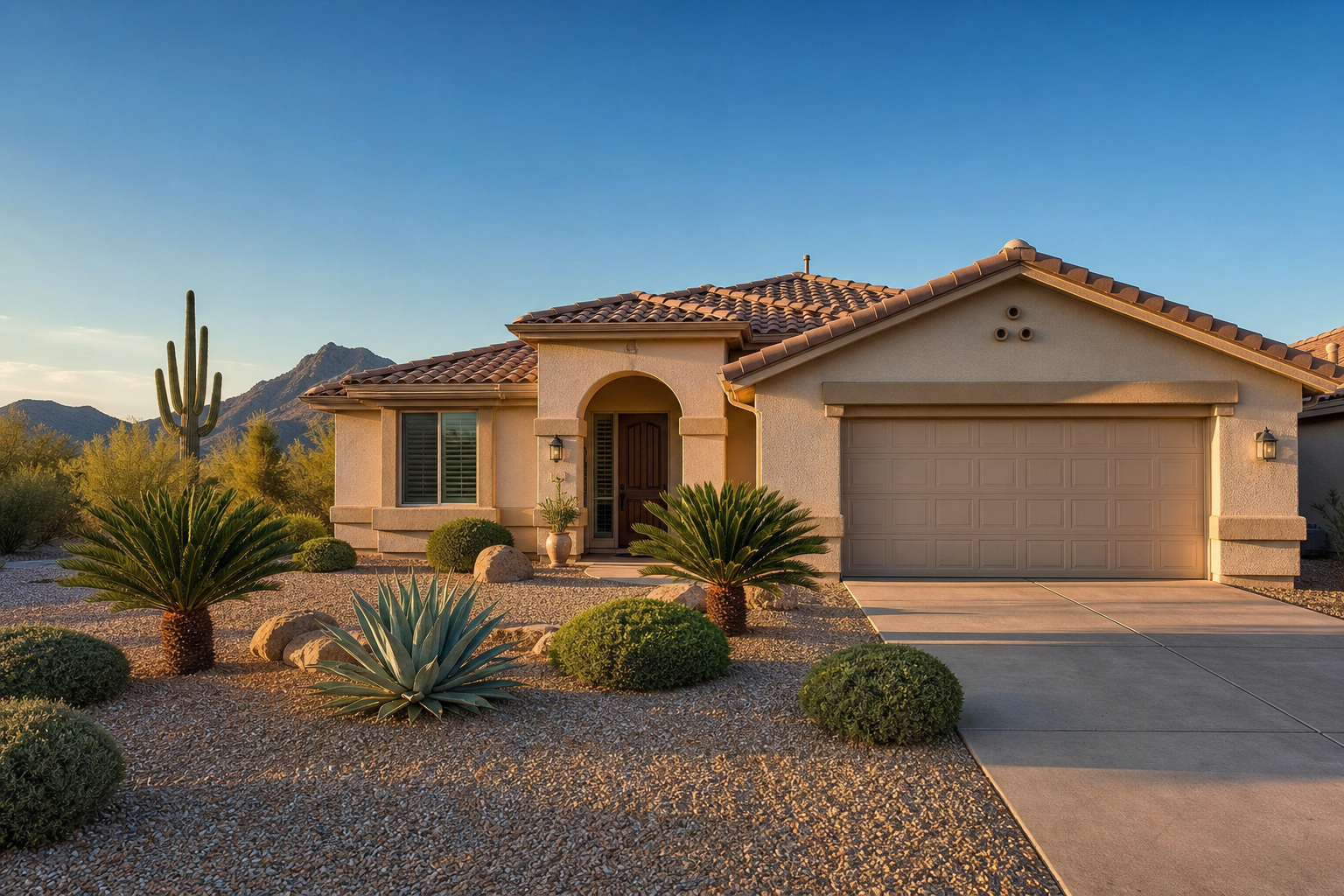
Curb appeal advice written for Ohio does not work here. You don’t have a lawn to mow. What you have is gravel, gravel gets dusty and full of weeds, and dust storms leave a film on everything. Nine out of ten Valley homes need less than $1,000 of front-yard work to look 30% better.
- Refresh the rock. A gravel top-dress on a front yard reads as a brand-new yard for a few hundred dollars. Rake it level and edge the borders.
- Kill and pull weeds, then pre-emerge. Weeds in gravel are the number one “deferred maintenance” signal in a Phoenix listing photo.
- Trim, don’t remove. Skirt the palms, shape the sage and lantana, clear dead growth. Mature desert plants are an asset — a bare gravel lot is not.
- Pressure wash the driveway, walkway and stucco base. Sun-baked oil stains and dust lines photograph terribly.
- Wash every window inside and out. Hard-water spotting is a Valley constant and it dulls interior light in photos.
- Repaint or replace the front door and house numbers. Under $200, and it’s the frame of your primary listing photo.
- Check the irrigation timer. Dead plants two weeks into your listing are avoidable.
Bigger projects are available — a full landscape cleanup or refresh tier in Phoenix runs $1,500–$8,000 — but for most sellers that’s over-investment. Also, check your CC&Rs before you change anything visible from the street: many Valley HOAs have approved plant and gravel lists. Here’s how to find your CC&Rs in Arizona if you don’t have yours.
Step 4: Staging — what it costs and whether it’s worth it
Staging is the prep item sellers argue with me about most, so let’s use data instead of opinion.
| Staging finding | Data point | Source |
|---|---|---|
| Agents reporting a 1–10% increase in dollar value offered | 29% of agents | NAR 2025 Profile of Home Staging |
| Buyers’ agents saying staging helps buyers visualize the home | 83% | NAR 2025 Profile of Home Staging |
| Most important room to stage | Living room (37%), then primary bedroom (34%), kitchen (23%) | NAR 2025 Profile of Home Staging |
| Sellers’ agents who stage every listing | 21% | NAR 2025 Profile of Home Staging |
| Phoenix professional staging, 30 days, 1,800–2,200 sq ft | $2,000–$5,000 | soldphx.com, June 2026 |
| Phoenix staging monthly renewal | $800–$1,200 | soldphx.com, June 2026 |
| Hourly consultation / redesign of your own furniture | $120–$130 per hour | ProMatcher, Phoenix |
My honest read: vacant homes need staging; occupied homes usually need editing, not staging. A vacant 2,000 sq ft Phoenix house photographs as a series of empty beige boxes and buyers cannot judge scale. Spend the $2,000–$3,000. If you still live there, a $300 two-hour consultation plus a weekend of decluttering and a storage unit gets you 80% of the benefit. Rule of thumb: remove one third of your furniture and two thirds of everything on your walls and counters.
Weigh the cost against carrying costs, not against zero. On a $500,000 Phoenix home, principal, interest, taxes and insurance plus HOA can easily run $3,500–$4,000 a month. If staging shortens your market time by three weeks, it paid for itself.
Step 5: Photography, and shooting at the right hour
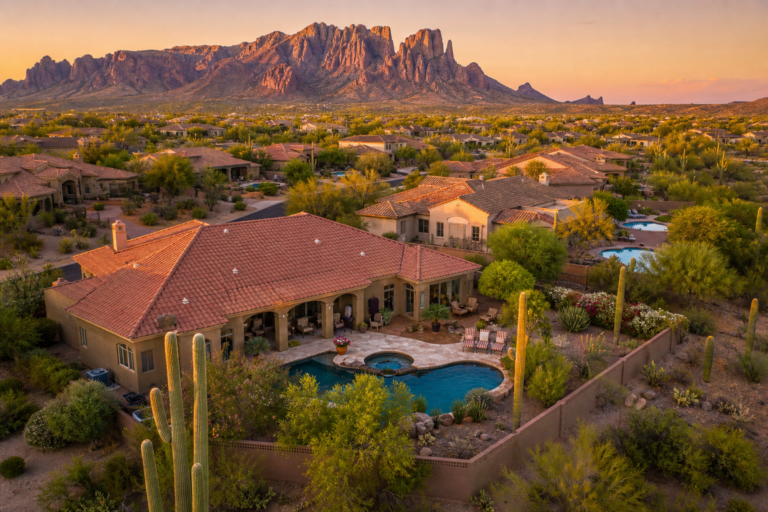
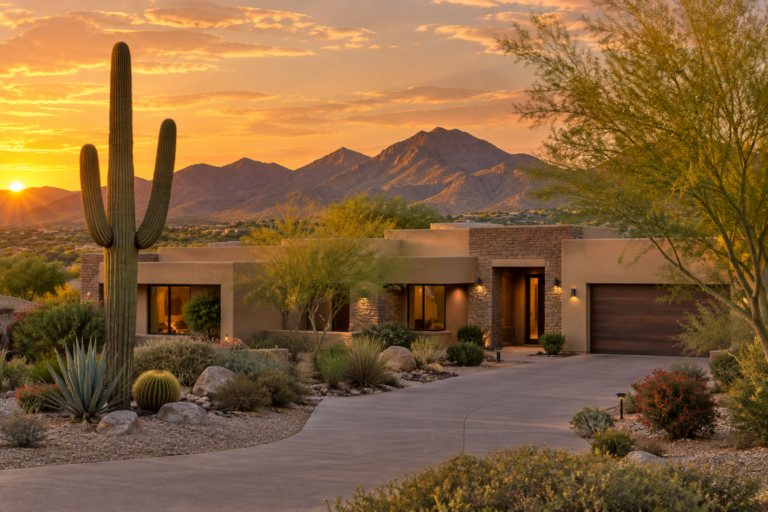
Your listing photos are your first showing. In Arizona there’s a technical wrinkle most sellers never hear: the direction your house faces determines what time of day it should be photographed. A west-facing front elevation shot at 10 a.m. is in flat shadow. Shot at 6 p.m. in July, the same house glows. A good Arizona photographer will ask about orientation before scheduling.
- Professional photography, not the agent’s phone. Arizona listing photography is standard practice at every price point now.
- Twilight exterior shot if you have a pool, a mountain view, or good outdoor lighting. It is the most-clicked photo type in the Valley.
- Drone for lot size, mountain proximity, golf frontage, or a large yard.
- Floor plan — relocation buyers from out of state rely on it heavily.
- Video walkthrough for anything above the metro median.
- Turn on every light, open every blind, remove cars from the driveway, hide trash cans and hoses, and take the pool cleaner out of the pool.
One more: photograph a shaded patio or misting system if you have one. Shade is a genuine amenity here and buyers relocating from cooler states are learning to look for it.
Step 6: Price it off data, not off hope
This is where most Phoenix listings fail. Sellers pick a number from 2022 or from what a neighbor asked (not got), the listing sits three weeks, and then they chase the market down with cuts. Remember: 53% of active Phoenix listings currently show a price reduction, and the average seller still nets 98.1% of list. Both facts are true because the sellers who priced right never had to cut.
- Have your agent build a real CMA off closed sales in the last 90 days within your subdivision or a half-mile radius, adjusted for square footage, lot, pool, and condition.
- Look at expired and cancelled listings too. They tell you where the ceiling is.
- Check active competition. You are not competing with what sold in April, you are competing with the six homes a buyer will tour on Saturday.
- Price into a search bracket. Buyers search $450,000–$500,000, so listing at $505,000 hides you from an entire pool of buyers.
- Plan your reduction schedule in advance: if you have fewer than eight showings in 14 days, or no offer in 21, the market is telling you the price is wrong.
- Do not price high to “leave negotiating room.” In a 78-day-average market, overpriced homes get no offers to negotiate.
A CMA is not an appraisal, and the difference matters once you’re under contract — I explained it in CMA vs. appraisal. For pricing mechanics specifically, see how to price your home right in 2026. You can also get a starting figure from my what is my home worth in Phoenix tool.
Step 7: Disclosures — the SPDS is not a formality
Arizona is a disclosure state, and this is where sellers get sued. Arizona law requires you to disclose material facts about the property even if nobody asks you, and that obligation survives even if you and the buyer agree not to exchange an SPDS at all.
- SPDS timing. Under the Arizona REALTORS® Residential Resale Purchase Contract, you must deliver a completed SPDS to the buyer within three days after contract acceptance. Miss it and you are potentially in breach, which lets the buyer cancel and take the earnest money.
- The buyer does not have to sign it. There’s no contractual obligation for the buyer to return a signed SPDS, so don’t hold the file hostage over it.
- Buyer response window. The buyer has the inspection period or five days after receiving the SPDS, whichever is later, to disapprove items.
- Fill it out yourself, weeks early. Do it during prep, not the night it’s due. Attach invoices and warranties for every repair you mention.
- Lead-based paint. Homes built before 1978 require the federal disclosure and pamphlet.
- HOA and CC&Rs. Order your resale disclosure package early; Arizona caps the fee and gives a 10-day delivery window.
- Unincorporated land. An Affidavit of Disclosure is required for properties in unincorporated county areas meeting the statute’s parcel criteria.
- When in doubt, disclose. Every dollar I’ve seen a seller lose to a disclosure fight was larger than the concession they were trying to avoid.
Step 8: Pick the agent before you pick the paint color
Interview at least two, ideally three. Commission in Arizona averages 5.82% total (about 2.9% each side), which on a $510,000 Maricopa County home is roughly $29,700 — so ask hard questions before you sign anything for six months.
- What is your list-to-sale price ratio and average days on market in my ZIP code, over the last 12 months?
- How many of your listings in the past year expired or cancelled without selling?
- What exactly is included — photography, video, floor plan, staging consultation, print, paid social?
- Who covers showings and communication when you’re unavailable?
- What is your written price reduction protocol if we get no offer in 21 days?
- How are you handling buyer-agent compensation post-settlement, and what will you recommend for my listing?
- What is the cancellation policy on your listing agreement?
I put the longer version of this list in questions to ask a real estate agent and why you should interview multiple agents. Read both before you sign a six-month agreement with anyone, including me.
Step 9: Negotiating in a market where buyers have leverage
Prep gets you offers. Negotiation gets you a closing. In 2026 Phoenix, the fight is rarely just about price — it’s about repairs, concessions and rate buydowns.
- Concessions beat price cuts. A $10,000 credit toward a rate buydown often means more to a payment-focused buyer than $10,000 off the price, and it protects your comp for the neighborhood.
- Answer the inspection with documents, not emotion. If you did the pre-listing inspection in Step 1, you already have bids and receipts. That reframes the negotiation instantly.
- Watch the appraisal. With prices flat to slightly down, appraisal gaps happen. Have your comp package ready to hand the appraiser.
- Know the buyer’s loan. FHA and VA files take longer and have property condition standards — peeling paint, missing handrails, a non-functional cooling system.
- Vet the offer, not just the number. Earnest money size, lender quality, contingency count and the buyer’s own home sale matter more than $5,000 on the top line.
- Keep a backup plan. With a 65% listing success rate, a fallen-through contract is a real risk. Stay on good terms with your second-best offer.
If you’re selling and buying at the same time, sequencing gets complicated fast — I covered the options in how to buy and sell at the same time in Phoenix.
What the whole thing costs
Rough budget for a $510,000 Maricopa County home, from prep to closing table.
| Cost | Typical amount | Notes |
|---|---|---|
| Pre-listing inspection + termite | $400–$750 | Optional, highest-ROI line here |
| Repairs and touch-ups | $500–$8,000 | Wildly variable; disclose-and-credit the big items |
| Cleaning, landscaping, decluttering, storage | $800–$2,500 | Do not skip |
| Staging (vacant home) | $2,000–$5,000 for 30 days | Consultation only if occupied: ~$300 |
| Photography / video / floor plan | Often included by your agent | Confirm in writing |
| Total commission at 5.82% | ~$29,700 | Negotiable; buyer-side compensation is now negotiated separately |
| Title, escrow, recording, HOA transfer, prorations | ~1–3% of price | Arizona sellers customarily pay owner’s title policy and half of escrow |
| All-in seller cost | typically 6–9% of sale price | See my full breakdown of seller closing costs in Arizona |
The one-page checklist
- Order a pre-listing inspection and termite report (90–60 days out).
- Interview two to three agents; get a data-backed pricing opinion from each.
- Fix safety, water, roof, and HVAC items. Get written bids for anything you’re not fixing.
- Paint interior neutral; touch up exterior only where visible.
- Declutter one third of furniture, two thirds of surfaces and walls. Rent a storage unit.
- Deep clean including windows, grout, vents, and the garage floor.
- Refresh gravel, pull weeds, trim plants, pressure wash hardscape, repaint the front door.
- Stage if vacant; consult if occupied.
- Professional photos, video and floor plan — scheduled for the right time of day for your home’s orientation.
- Complete the SPDS with invoices attached; order the HOA resale package.
- Set the price off closed comps from the last 90 days plus current active competition.
- Go live midweek, hold the first open house that weekend, and track showings against a 14-day and 21-day decision point.
What I’d skip entirely
- Kitchen and bathroom remodels. You will not recover a $45,000 kitchen in this market and the buyer likely wants different finishes.
- Pool installation. Never do it to sell. The ROI is negative and it eats months.
- Solar additions. Leased systems complicate closings; adding one right before listing is a mistake.
- Bold paint or trendy tile. Neutral wins.
- Converting the garage. In Phoenix, covered parking is a feature, not a spare room.
- Grass. Putting in a lawn to appeal to out-of-state buyers backfires on water cost and HOA rules.
The honest summary
Selling in Phoenix in 2026 is very doable. It is not 2021. You get 98 cents on the dollar and about 78 days on market if you show up prepared, and you get expired-listing status and three price cuts if you don’t. The gap between those two outcomes is usually $3,000 to $6,000 of preparation and one honest conversation about price.
I would rather have that honest conversation with you now than a painful one in week seven.
What should I do before selling my home in Phoenix?
Start with a pre-listing inspection 60 to 90 days out, fix safety, water, roof and HVAC issues, then clean, declutter, refresh the front-yard gravel, stage if the home is vacant, and shoot professional photos. Price off closed comps from the last 90 days and complete your SPDS before you go live. Doing it in that order keeps you from paying for the same work twice.
How much does it cost to prepare a home for sale in Phoenix?
Most Phoenix sellers spend $3,000 to $8,000 preparing a home for sale, and total selling costs land around 6% to 9% of the sale price once commission, title and escrow are included. A $400 pre-listing inspection, $800 to $2,500 of cleaning and landscaping, and $2,000 to $5,000 of staging on a vacant home cover the essentials.
Do I have to fix everything before listing my house in Arizona?
No. Fix anything affecting safety, water intrusion, or the buyer’s ability to get a loan, and disclose plus credit the expensive cosmetic items. A written roof or HVAC credit costs the same as the repair but takes zero calendar days, which matters in a market averaging 78 days on market.
What disclosures does an Arizona home seller have to make?
Arizona law requires sellers to disclose all material facts about the property even if nobody asks, and the Arizona REALTORS® contract requires delivery of a completed SPDS within three days after contract acceptance. Pre-1978 homes also need the federal lead-based paint disclosure, and HOA resale packages must be ordered early.
How long does it take to sell a home in Phoenix in 2026?
Expect roughly 90 to 120 days from listing to closing in Phoenix right now: about 78 days average on market plus a 30 to 45 day escrow. Add 60 to 90 days of prep if you are doing repairs, staging and photography properly.
Ready to get your Phoenix home listed the right way?
Send me your address and I will walk your home with you, tell you exactly which items on this checklist matter for your house, and give you a real price range built off closed comps — not a number designed to win your listing. If prep is going to take three months, I will tell you that too. Get in touch here, or start with a free home selling consultation.
— Robbie Holycross, RJH Homes Team