
Home Inspection in Arizona: What the Desert Does to Your House
I have stood in a lot of Arizona garages at 7 a.m. watching an inspector pull the cover off a 19-year-old air conditioner while my buyer holds their coffee and hopes for the best. The home inspection Arizona buyers get is not the same inspection their friends got in Ohio or Illinois. Same checklist on paper. Completely different failure points in reality.
The desert does specific things to a house. Ultraviolet light bakes roof underlayment until it turns to cornflakes. A hundred-plus days a year above 100 degrees grinds down HVAC equipment years before its warranty runs out. Desert subterranean termites work year-round because the ground never freezes. Monsoon storms drive rain sideways into stucco cracks that looked cosmetic in April. And the soil under your slab expands and collapses depending on how much water reaches it.
None of that means Arizona homes are bad homes. It means the inspection has to be read differently, and the repairs have to be priced differently. Here is what I tell every client before their inspector shows up, including what the numbers actually look like in 2026, what is worth negotiating over, and what is just how houses work out here.
How the Arizona inspection period actually works
In Arizona, most resale purchases run on the Arizona REALTORS® Residential Resale Purchase Contract, and that contract gives the buyer a 10-day inspection period from contract acceptance to inspect the property and deliver a written list of items they want corrected. Ten calendar days — not business days. Holidays and weekends count. If day 10 lands on a Sunday, you get until the end of that Sunday.
That window is doing a lot of work. Inside it you are scheduling the general inspection, any specialty inspections it triggers, reviewing the seller’s disclosure, walking the property yourself, and negotiating repairs. Good inspectors in the Valley book out three to five days in peak season. If you sign on a Friday and call an inspector on Wednesday, you have already lost.
The other document doing heavy lifting is the SPDS — the Seller’s Property Disclosure Statement. Arizona sellers fill out a multi-page form covering known defects, past repairs, roof age, pool equipment, water source, and whether the property sits in a flood or fissure area. Read it before your inspection, not after. It tells your inspector where to look hard. I cover this in more detail in my guide to buying your first home in Phoenix.
One thing that surprises out-of-state buyers: Arizona licenses home inspectors, and the bar is real. Under Arizona Administrative Code R4-30-247 and A.R.S. §32-122.02, a certified home inspector has to pass the National Home Inspector Examination, complete 84 hours of classroom training, log 30 parallel inspections with a supervising inspector, hold a fingerprint clearance card, and carry errors-and-omissions insurance or a bond. Certification renews annually through the Arizona State Board of Technical Registration. Ask for the certificate number. Verify it.
What a home inspection costs in Arizona in 2026
A standard buyer’s inspection in the Phoenix metro runs $300 to $600 for most homes, scaling with square footage and age. Statewide averages land around $380 per inspection. The real budget conversation is not the base inspection — it is the add-ons, and in Arizona you will want several of them.
| Inspection type | Typical 2026 cost | Who needs it |
|---|---|---|
| Standard inspection, under 1,500 sq ft | $275 – $400 | Everyone |
| Standard inspection, 1,500 – 2,500 sq ft | $375 – $500 | Everyone |
| Standard inspection, 2,500 – 3,500 sq ft | $450 – $550 | Everyone |
| Luxury / 5,000+ sq ft | $650 – $900+ | Zoned HVAC, casitas, custom builds |
| Termite / WDI report (NPMA-33) | $75 – $150 | Every AZ buyer; required by many VA and FHA lenders |
| Pool and spa inspection | $125 – $250 (over $1,000 on large custom pools) | Any home with a pool |
| Sewer scope | $150 – $300 | Homes built before ~1985, or with mature trees |
| Septic inspection and transfer of ownership | $400 – $900 | Rural parcels, Queen Creek and outlying areas |
| Thermal imaging add-on | $100 – $200 | Older homes, suspected roof or plumbing leaks |
Bundling matters. Most Valley inspection companies will run the general inspection, termite report and pool inspection in one visit for less than booking three vendors separately. On a typical Gilbert or Chandler resale with a pool, plan on $600 to $800 all in. That is a rounding error against a $577,000 purchase, and it is the cheapest leverage you will ever buy. If you want the full picture of what closing actually costs, I broke it down in the hidden costs of buying a home in Arizona.
The roof: it is almost never the tile
Drive any neighborhood built between 1995 and 2005 and you will see concrete tile roofs that look fine from the street. The tile is fine. Concrete tile lasts 50 years or more out here. The part that fails is the underlayment beneath it — the felt or synthetic membrane that is actually keeping water out of your house.
National charts say underlayment lasts 30 to 40 years. Arizona roofers will tell you the real number on 1990s-era 30-pound felt is closer to 15 to 25 years, because UV radiation and 115-degree attic temperatures dry it out until it cracks. Then monsoon rain gets driven under the tile at valleys, flashing and penetrations, and you find out about it through a ceiling stain.
A tile re-felt — lifting the existing tile, stripping the old underlayment, rebuilding flashing, and resetting the same tile — is the dominant roof project in the Valley. Contractor data compiled from HomeAdvisor and Angi across the Phoenix metro puts most re-felts between $15,000 and $35,000, with per-square-foot planning ranges of roughly $4 to $8 for underlayment-focused work. Solar panels that have to be detached and reset add to that.
So the question I want answered on every inspection is not “how does the roof look.” It is: what year was the underlayment last replaced? A 2003 home with original felt is on borrowed time. A 2003 home that was re-felted in 2019 has 20 good years ahead of it. Same roof from the curb. A $25,000 difference in reality. Ask for the invoice.
Flat and foam roofs are their own conversation. Sprayed polyurethane foam with an acrylic coating is common on midcentury Arcadia and Phoenix homes, and it needs recoating roughly every 5 to 10 years. That is a $2,500 to $6,000 maintenance item, not a repair, and skipping it is what turns a coating job into a tear-off.
HVAC: the single most expensive number in your inspection
Phoenix sits in climate zone 2B. Cooling runs nine months a year and the system never gets the winter break equipment engineers designed it for. The result is a compressed lifespan. Manufacturers project 15 to 20 years. In the Valley, expect 10 to 15, and 8 to 12 if the unit was undersized or poorly maintained.
| System | Phoenix installed cost, 2026 | Valley lifespan | Notes |
|---|---|---|---|
| AC only, split system | $5,400 – $10,500 | 10 – 15 yrs | Reuses existing ductwork and furnace |
| AC only, 4 – 5 ton (2,500+ sq ft) | $8,000 – $14,200 | 10 – 15 yrs | Heat load pushes most Valley homes to 4-5 ton |
| Full system (AC + furnace) | $7,500 – $15,500 | 12 – 18 yrs well maintained | Typical whole-home replacement |
| Heat pump, full system | $7,000 – $14,500 | 12 – 15 yrs | Gaining share; one unit for heat and cool |
| Ductless mini-split, 1 – 2 zone | $3,500 – $8,500 | 12 – 15 yrs | Casitas, garages, additions |
| City mechanical permit | $150 – $230 | — | Required; confirm the contractor pulls it |
What I want off the inspection report: the manufacture date on the condenser data plate, the temperature split across the coil, the condition of the ducting in the attic, and whether the system is even sized right for the square footage. An inspector will tell you the unit “functions.” A functioning 2008 unit in a 2026 Arizona summer is a replacement you are going to make, on your dime, probably in July, probably at a premium.
Practical move: if the equipment is 12 years old or older and passing, that is a legitimate ask in negotiation — usually as a seller credit rather than a replacement, because you want to pick your own contractor and equipment tier. In a market where Maricopa County buyers are getting real concessions, this is exactly the kind of item that gets funded. I wrote about how that negotiation is actually going in this piece on Phoenix negotiation leverage.
Termites: not a red flag, a maintenance category
This one rattles buyers from other states more than anything else. Arizona has three destructive termite species active across the metro: the desert subterranean termite (Heterotermes aureus), the arid-land subterranean termite, and the western drywood termite. The desert subterranean is the one you will meet. It lives in soil, builds mud tubes up through foundation cracks and expansion joints, and it stays active year-round because the ground never freezes and Valley landscape irrigation keeps the soil moist.
Finding evidence of past termite activity in a 25-year-old Mesa home is close to normal. What matters is whether the activity is current, whether there is structural damage, and whether the home has a documented treatment history with a warranty. Ask for the last treatment invoice and whether the retreatment coverage is still in force.
| Item | Typical Phoenix cost, 2026 | Notes |
|---|---|---|
| WDIIR / NPMA-33 real estate report | $75 – $150 | 30-day validity window; often lender-required on VA and FHA |
| Liquid soil barrier treatment (Termidor SC type) | $400 – $800 | Handles roughly 90% of Valley homes |
| Bait station system, installed | $800 – $1,500 | Includes first year of monitoring |
| Drywood spot treatment | $396 – $696 | Older Arcadia, Coronado, downtown Mesa wood-frame |
| Full treatment on a typical Phoenix home (metro range) | $1,300 – $3,800 | Varies by foundation type and infestation extent |
| Annual renewal / warranty | $150 – $400 per year | Keeps retreatment coverage alive |
Note what is not on that list: whole-structure tent fumigation. That is a Florida and coastal California norm. In the Valley it is rarely needed, because the dominant species lives in the soil and responds to perimeter treatment.
Soil, slabs, and the cracks that actually matter
Arizona has no basements and, for most buyers, no frost line to worry about — so people assume foundations sit still. They do not. The Arizona Geological Survey documents both expansive shrink-swell clays and collapsing soils across the state, and nationally, expansive soils cause more damage to homes each year than floods, tornadoes and hurricanes combined.
Out here the movers are caliche shelves that trap water under a slab, expansive clay that swells during monsoon saturation and shrinks in drought, and groundwater-related subsidence and earth fissuring in parts of the Valley. A peer-reviewed hedonic study of 82,716 Maricopa County sales found measurable negative price effects for properties in subsidence features and near earth fissures — this is a documented value issue, not a scare story.
What I look at, in order
- Drainage and grading. Does water move away from the house? Negative grading, buried scuppers, clogged drainage channels and hardscape that dams water against the stem wall cause more slab movement than the soil does. This is usually the cheapest fix on the whole report and the most valuable.
- Crack pattern, not crack count. Hairline vertical cracks in stucco at control joints are cosmetic. Diagonal cracks running off the corners of windows and doors, doors that stick seasonally, and separated baseboards are movement.
- Interior versus exterior agreement. When exterior stucco cracks line up with interior drywall cracks in the same plane, that is structure. When they do not, it is finish.
- Fissure mapping. The Arizona Geological Survey publishes earth fissure maps. If the property is in or near a mapped area, I want a structural engineer, not an opinion.
A structural engineer’s evaluation runs roughly $400 to $900 in the metro. If your general inspector uses the phrase “recommend further evaluation by a qualified structural engineer,” get it done inside your ten days. That sentence is not filler; it is the inspector telling you the answer is above their license.
Stucco, monsoon water intrusion, and the pool
Stucco performs well in this climate right up until wind-driven rain finds a path. Inspectors in the Valley consistently flag stucco cracking and moisture intrusion points around windows, doors, exterior penetrations and expansion joints. Most hairline cracking is cosmetic. The ones that matter are the ones with a path behind them — and the tell is interior staining, peeling paint, musty odor, or damp insulation in the attic below a roof penetration.
If the home has any history of leaks, pay the extra $100 to $200 for thermal imaging. Moisture behind a wall shows up on infrared weeks before it shows up on drywall.
Then there is the pool, which about a third of my buyers end up with whether they planned to or not. A pool is a second mechanical system with its own inspection, and Arizona is unusually hard on it: year-round operation, 115-degree ambient temperatures, monsoon dust loading the filters, and famously hard water that scales everything it touches.
| Pool component | Typical lifespan (Valley-adjusted) | Replacement cost |
|---|---|---|
| Pump, single-speed | 8 – 12 yrs | $700 – $1,500 |
| Pump, variable-speed | 10 – 15 yrs | $1,500 – $2,500+ |
| Cartridge or sand filter tank | 15 – 20 yrs | $400 – $1,200 |
| Gas heater | 8 – 12 yrs | $2,500 – $5,000 |
| Salt chlorinator cell | 3 – 7 yrs | $700 – $1,500 |
| Plaster surface (replaster) | 10 – 15 yrs in AZ heat | $5,000 – $10,000 |
| Pebble finish | 15 – 20 yrs | $8,000 – $15,000 |
Two things get missed on pools constantly. First, barrier and safety compliance — Arizona pool fencing, self-closing gate hardware and door alarms are code items, and a non-compliant barrier is both a liability and, sometimes, an insurance problem. Second, electrical bonding at the equipment pad. Old, corroded bonding on a 1990s pool is a genuine safety defect, not a nitpick.
How to actually use the report
The inspection is not a to-do list you hand the seller. It is information. Sellers in Arizona are not obligated to fix anything, and a buyer who submits a 40-line repair request with light bulbs and outlet covers on it burns the goodwill they need for the roof conversation.
My rule for what to ask for
- Ask: safety defects (electrical, bonding, gas, pool barrier), active water intrusion, active termite activity, roof leaks or end-of-life underlayment, HVAC that is failing or 12+ years old, sewer or septic defects, structural movement confirmed by an engineer.
- Consider: deferred maintenance with a real dollar cost — foam roof recoating, pool equipment at end of life, water heater over 10 years.
- Skip: cosmetic stucco hairlines, cracked pavers, missing screens, dirty filters, minor caulking, anything under about $200 that you can handle in a weekend.
And bias toward credits over repairs. A seller-arranged repair is done by the cheapest bidder on a deadline. A $6,000 credit lets you hire your own roofer after you own the house. On the seller side of the table, the counter-move is a pre-listing inspection — I talk through that and the rest of the prep sequence in how to increase your home value before selling and in my guide to pricing your home right in 2026.
What this looks like on a real Valley house
Here is a composite that could be almost any 2001-built, 2,300-square-foot home in Gilbert, Chandler or Mesa that I walk through in a given month.
| Finding | Verdict | Estimated cost | Action |
|---|---|---|---|
| Original 2001 tile underlayment, no re-felt on record | End of life | $18,000 – $28,000 | Ask for credit; get two roofer bids inside the 10 days |
| AC condenser dated 2011, functioning, 4-ton | Aging, not failed | $8,000 – $14,200 | Ask for partial credit; budget for it regardless |
| Evidence of prior subterranean termite activity, no active tubes | Normal for age | $150 – $400/yr | Request treatment records; put a warranty in place |
| Hairline stucco cracks at three control joints | Cosmetic | Under $500 | Skip |
| Negative grading on north side, water pooling at stem wall | Real issue, cheap fix | $500 – $2,000 | Ask for correction or credit |
| Pool pump single-speed, dated 2014; plaster showing wear | Deferred maintenance | $700 – $1,500 pump; $5,000 – $10,000 replaster | Credit-worthy; plan the replaster |
| Water heater 2013 | Aging | $1,400 – $2,600 | Budget item, not a negotiation |
Total realistic near-term exposure on that house: $30,000 to $45,000 over the next three to five years. That is not a reason to walk. It is a reason to know before you sign, and to make sure the price and the credits reflect it. The buyer who gets hurt is the one who waived the inspection to win a bidding war and met the roof in August.
Choosing the right inspector
- Confirm the certification number with the Board of Technical Registration and check that E&O insurance or a bond is current.
- Ask how many inspections they do per day. Three or more on 2,500-square-foot homes means someone is getting a fast look.
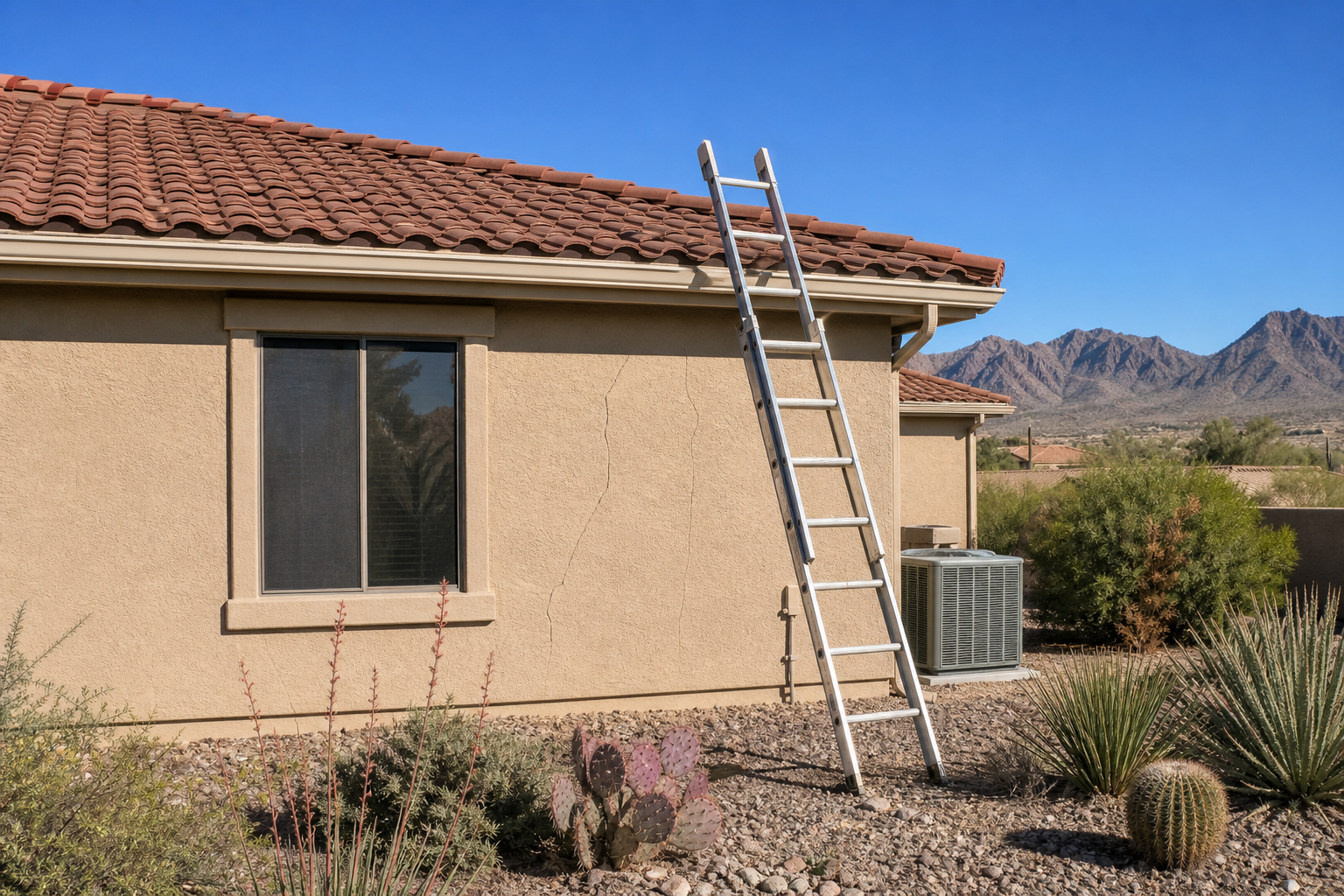
- Ask specifically what they will and will not walk. Tile roofs can be walked by experienced inspectors; some will only view from a ladder or drone. Both are acceptable, but know which you are paying for.
- Ask for a sample report. You want photos, locations, and severity ratings — not a 90-page boilerplate PDF where the real findings are buried.
- Be there. Follow them for the last 30 minutes and ask what they would fix first if it were their house. That verbal answer is often worth more than the written report.
And a note on my own role: I will give you names, but I do not want a financial relationship with your inspector, and you should be suspicious of any agent who steers you to one person and gets defensive about it. Your inspector’s job is to talk you out of the house if the house deserves it.
The bottom line
A home inspection in Arizona costs $300 to $600 plus a few hundred in essential add-ons, and it is the highest-return money in the transaction. But it only pays off if you read it through a desert lens: roof underlayment age over roof appearance, HVAC manufacture date over “it cools,” termite history over termite panic, drainage over crack counting, and pool equipment as a real capital line item.
Older housing stock is not the enemy. Unknown deferred maintenance is. Get the dates, get the invoices, get the bids inside your ten days, and negotiate on documented numbers instead of vibes.
How much does a home inspection cost in Arizona?
A standard home inspection in Arizona costs $300 to $600, with the statewide average around $380. Price scales with square footage: under 1,500 sq ft runs $275-$400 while a 2,500-3,500 sq ft home runs $450-$550. Budget another $75-$150 for the termite report and $125-$250 for a pool inspection, which most Valley buyers need.
What do Arizona home inspectors find most often?
The most common Arizona findings are aged roof underlayment, HVAC nearing end of life, termite evidence, stucco cracking, and poor drainage around the foundation. The desert climate drives all five: UV radiation degrades roof underlayment, 110-plus degree summers cut AC lifespan to 10-15 years, and desert subterranean termites stay active year-round because the soil never freezes.
How long is the inspection period in Arizona?
Arizona’s standard resale purchase contract gives buyers 10 calendar days from contract acceptance to inspect and deliver a written repair request. Weekends and holidays count. Because good Valley inspectors book three to five days out, you should schedule the inspection the same day your contract is accepted.
Is a termite inspection required when buying a house in Arizona?
A termite inspection is not required by state law, but many VA and FHA lenders require one, and every Arizona buyer should get it. The NPMA-33 wood-destroying insect report costs $75 to $150 and is valid for about 30 days. Evidence of past subterranean termite activity is common on older Valley homes; what matters is whether activity is current and whether a treatment warranty is in force.
Are home inspectors licensed in Arizona?
Yes. Arizona home inspectors must be certified by the State Board of Technical Registration. Certification requires passing the National Home Inspector Examination, 84 hours of classroom training, 30 supervised parallel inspections, a fingerprint clearance card, and current errors-and-omissions insurance or a bond, with annual renewal. Always ask for and verify the certificate number.
Buying in the Valley? Let me put the right inspector in front of you.
I will tell you which findings are real, which are noise, and what the repairs actually cost out here before your ten days run out. If the house does not deserve your money, I will say so. Reach out here and let us look at it together.
— Robbie Holycross, RJH Homes Team