
How TSMC and Intel Are Reshaping Phoenix Real Estate in 2026
I get some version of this question every week now: “Robbie, is the chip stuff actually moving the market, or is that just something agents say to get you to buy?”
Fair question. So let me give you the honest version. The semiconductor buildout in Maricopa County is real, it is enormous, and it is the single biggest structural change to our economy since the Valley became a retirement destination. It is also slower and more geographically concentrated than the headlines suggest. If you buy a house in Buckeye today because TSMC announced another $100 billion, you are going to be disappointed. If you understand where the money actually lands and on what timeline, there is a genuinely good investment case here.
Here is what I know as of late August 2026, with sources, and what I would actually do about it.
The scale of what is being built in Maricopa County
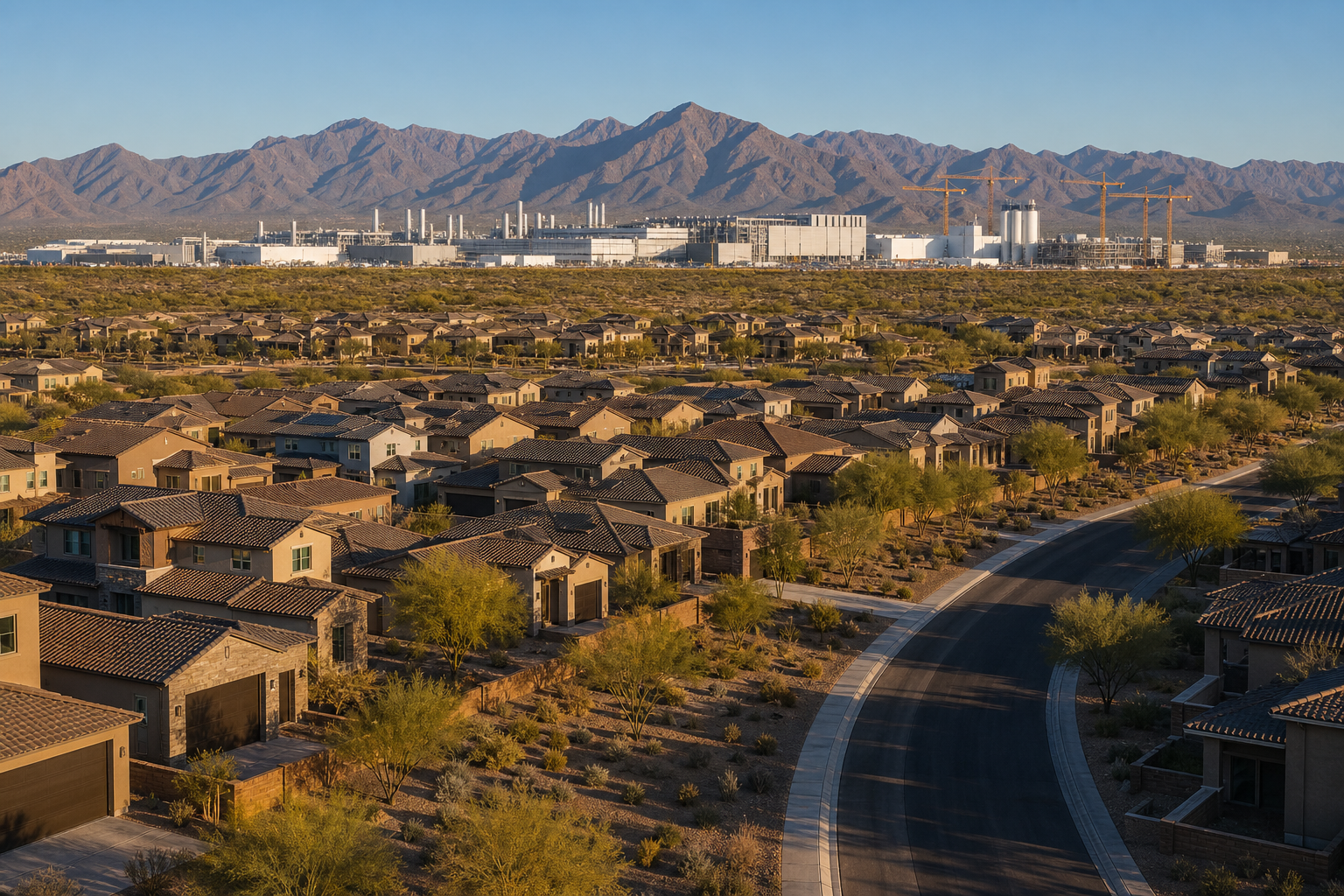
On July 16, 2026, TSMC announced an additional $100 billion for its Arizona operations — four or more new fabs running 2-nanometer and more advanced processes. That brings the company’s total Arizona commitment to $265 billion, which the Arizona Commerce Authority describes as the largest single foreign direct investment in U.S. history. The full plan is now 10 fabrication plants, two advanced packaging facilities, and an R&D center on the north Phoenix campus (Arizona Commerce Authority).
For perspective on what that means beyond the dollar figure: TSMC says roughly 30% of its global 2nm-and-below capacity will eventually sit in north Phoenix. That is not a branch plant. That is a leading-edge cluster (Engineering News-Record).
Thirty miles southeast, Intel has been in Chandler since the 1980s and just brought Fab 52 at the Ocotillo campus fully online for its 18A process — the node behind Panther Lake and the Clearwater Forest server chips. It is the fifth high-volume fab on that campus, with Fab 62 still under construction and expected to be ready around 2028 (Data Center Dynamics).
| Item | TSMC (north Phoenix) | Intel (Chandler) |
|---|---|---|
| Announced investment | $265B total, incl. +$100B July 2026 | $20B+ committed to Ocotillo expansion |
| Facilities planned | 10 fabs, 2 packaging plants, R&D center | 6 high-volume fabs (Fab 52 live, Fab 62 ~2028) |
| Leading node | N4 in production; N3 volume 2027; N2 next | Intel 18A, ramping since Oct 2025 |
| Current AZ headcount | 3,500+ employees | 12,000+ employees (largest U.S. site) |
| Location | Loop 303 & I-17, ~25 mi north of downtown | SE Chandler, ~20 mi southeast of downtown |
| Buildout horizon | Beyond 2030 | 2028+ for Fab 62 |
Two campuses, 45 to 55 miles apart, on opposite ends of the metro. That single geographic fact drives almost everything else in this article. There is no such thing as “the chip corridor” as one housing market. There are two of them, and they behave differently.
What the fabs have actually done to home prices — and what they haven’t
This is where I have to be careful, because this is the part agents oversell.
The countywide market is soft. Through the first seven months of 2026, the Maricopa County median single-family price held flat at $510,000, average days on market rose to 78 from 73 a year earlier, and sellers received 98.1% of asking on average with 3.6 months of supply (Arizona Digital Free Press, August 2026). ARMLS put the Q2 2026 county median at $474,850 with 81 days on market (ARMLS Quarterly Housing Summary, Q2 2026). A quarter-trillion dollars of chip investment has not made Maricopa County a seller’s market.
What it has done is create pockets. The 85085 zip code around Norterra and Union Park — the closest established housing to TSMC’s Fab 21 — has clearly separated from the metro average.
| Metric | Greater Phoenix | Norterra / 85085 corridor |
|---|---|---|
| Median home price | ~$455,000 | ~$615,000 |
| Days on market | ~56 | ~51 |
| Sale-to-list ratio | ~97.2% | 96.4% – 97.5% |
| Average single-family rent | $1,567/mo | ~$2,650/mo |
A near-70% rent premium and a $160,000 price gap versus the metro median is not noise. Communities within 15 to 20 minutes of Fab 21 have appreciated roughly 15% to 25% since 2022, while the metro as a whole has been flat to slightly down over the last twelve months.
But read the second column of that table again: sale-to-list in 85085 is actually a touch lower than the metro. Higher prices, similar negotiation. That tells you the premium is already priced into list prices, and buyers there are not in a bidding frenzy. You are buying a structurally supported neighborhood, not a rocket ship.
On the Chandler side the story is more about income than price. Chandler’s median household income of $108,095 is anchored by the Intel and Microchip cluster, and average rent runs $1,862 — a 21% rent-to-income ratio that is among the healthiest in the metro. That is a durable tenant base, not a speculative one. I broke down that market in more detail in my post on Chandler home values in 2026.
The timeline problem nobody wants to talk about
Here is the thing that separates a good investment thesis from a bad one: most of this workforce has not arrived yet.
TSMC employs about 3,500 people in Arizona right now. The announced buildout — 10 fabs plus packaging plus R&D — will eventually need multiples of that, plus the construction workforce, plus suppliers. But TSMC’s own CEO declined to commit to completion dates on the July earnings call, saying the schedule depends on customer demand. Fab 2 is built but does not hit volume production until 2027. Fab 3 broke ground in mid-2025. The four newest fabs do not have a public start date at all.
So when someone tells you north Phoenix is about to explode, the accurate version is: north Phoenix has a demand floor that gets stronger every year through roughly 2032. That is a very good thing to own. It is not a flip.
| Milestone | Status as of Aug 2026 | Housing implication |
|---|---|---|
| TSMC Fab 1 (N4) | In volume production since late 2024 | Already reflected in 85085 pricing |
| TSMC Fab 2 (N3) | Construction complete; volume production 2027 | Hiring wave lands 2026–2027 |
| TSMC Fab 3 (N2) | Under construction since mid-2025 | Construction jobs now, fab jobs ~2028 |
| TSMC Fabs 4–10 | Announced, no public schedule | Long-tail demand into the 2030s |
| Intel Fab 52 (18A) | Fully operational | Chandler hiring underway now |
| Intel Fab 62 | Under construction, ready ~2028 | Second Chandler wave late decade |
There is a labor-supply angle here too, and it cuts in favor of housing. One workforce analysis projected Chandler alone facing a deficit of about 7,000 semiconductor-specific technical roles, with senior photolithography searches running 120 to 150 days to fill. When employers cannot hire locally, they relocate people. Relocated people need housing, and they usually rent for a year first.
The supplier wave is the underrated story
The fabs get the headlines. The supply chain is what actually spreads the money around the region.
Casa Grande in Pinal County has now landed at least ten semiconductor suppliers, mostly chemical and gas companies that need rail access, cheap land, and a straight shot up I-10 to both campuses. Sunlit Arizona bought 40 acres there for $9.2 million in late 2025 for a hydrofluoric acid plant, after already opening a $100 million facility in Deer Valley in 2024 (AZCentral).
| Company | Location | Investment | What it makes |
|---|---|---|---|
| Sunlit Arizona | Deer Valley + Casa Grande (40 ac, $9.2M) | $100M+ built | High-purity hydrofluoric acid |
| KPPC Advanced Chemicals | Casa Grande | $120M phase 1, ~$500M planned | Ultrapure HCl, ammonium hydroxide |
| Chang Chun Arizona | Casa Grande | ~$300M, 200+ jobs | Electronic-grade chemicals |
| Kanto, LCY, Solvay, Air Products | West Casa Grande | Not disclosed | Chemicals and industrial gases |
| Three Taiwanese firms (Aug 2026) | Mack Innovation Park, Deer Valley | Land deals closed 8/10/26 | Fab support and logistics |
Why this matters for a homebuyer: supplier jobs pay well but not fab-engineer well, and they land in places like Casa Grande, Deer Valley, and the Loop 303 industrial corridor. That is where entry-level and mid-range housing demand shows up. It is a broader, lower-priced demand base than the fab itself, and it is arriving sooner.
Which neighborhoods actually benefit
Let me be specific, because “north Phoenix” covers a lot of ground.
Near TSMC (Loop 303 and I-17)
- Union Park at Norterra (85085) — the closest major community to the campus, purpose-built by Taylor Morrison, roughly $600K to $950K. Heavily absorbed by TSMC engineering families.
- Norterra core and Fireside at Norterra (85085) — established, amenity-rich, $500K to $800K, 8 to 15 minutes to the fab.
- Stetson Valley and Sonoran Foothills (85083/85085) — slightly older resale stock, better price per square foot.
- Anthem and north Peoria (85086/85383) — longer commute, meaningfully cheaper, the best value play in the corridor right now.
Near Intel (SE Chandler / Ocotillo)
- Ocotillo and south Chandler — walking distance to the campus, strong schools, the most established chip-worker housing in the state.
- Gilbert and Queen Creek — where Intel families go for newer construction and more square footage.
- Tempe and north Chandler — better for younger engineers who want ASU-adjacent nightlife and a reverse commute.
If you are weighing those southeast options against each other, my guide to the best Gilbert neighborhoods for families and my Queen Creek area guide go deeper than I can here. For the north side, start with the Phoenix relocation guide.
The honest risk list
I would rather lose a deal than sell you a story. Here is what could go wrong.
- Intel is not a sure thing. The company has run multiple rounds of large layoffs, cancelled fabs in Germany and Poland, and has said it may pause development of 14A and later nodes if it cannot land external customers. Fab 52 is real and running, but Chandler’s second wave is contingent on decisions being made in the next twelve months.
- TSMC’s later fabs have no schedule. Four-plus fabs were announced with an explicit “depends on market demand” caveat. AI demand is driving this. AI demand can slow.
- You may be buying the news. A $615K median in 85085 versus $455K metro-wide means a lot of the thesis is already in the price. Paying a corridor premium and then needing to sell in three years is how people lose money on good stories.
- Water and infrastructure. Fabs are water-intensive, and groundwater rules already constrain new subdivisions on the metro fringe. I wrote a full breakdown of Arizona’s water supply situation.
- New construction supply. Builders are not passive. Every acre near the 303 that can be entitled is being entitled. Supply eventually answers demand, which is why I usually prefer established communities with finished amenities over the newest phase — see new construction versus resale in Phoenix.
How I would actually play it
Depends who you are.
| If you are… | What I’d do | Why |
|---|---|---|
| Relocating for a fab job | Rent for 6–12 months in the corridor, then buy | Commute tolerance is personal, and 85085 rents are high but reversible |
| A long-hold investor | Buy 3–4 bed resale in 85083/85085/85086 or SE Chandler | ~$2,650 SFH rents in the corridor with a 6–10 year demand tailwind |
| A short-term flipper | Look elsewhere | The corridor premium is already priced; DOM is still ~51 days, not 10 |
| An existing 85085 owner | Hold, and do not panic on flat comps | Structural demand floor; the buildout runs past 2030 |
| A first-time buyer on budget | Anthem, north Peoria, or Casa Grande | Supplier jobs land there first and prices are $100K+ lower |
One practical note for investors: run your numbers on today’s rents, not projected ones. Phoenix median rent was $1,567 in March 2026, down 0.82% year over year, because the metro built a record amount of multifamily in 2023 and 2024. The corridor premium is real, but the metro backdrop is a renter’s market. If the deal only works on a rent increase you have not earned yet, it is not a deal. My post on investing in the Phoenix metro in 2026 walks through the underwriting I use, and the Phoenix cost of living breakdown covers the carrying costs people forget.
The bottom line
TSMC and Intel are not going to make every home in Maricopa County go up. That is not how this works. What they are doing is anchoring a high-wage, capital-intensive industry in two specific parts of the Valley for the next decade or more, in an economy that used to lean heavily on tourism, retirement, and construction. Economic diversification is boring and it is exactly what you want under your largest asset.
The corridors are already priced at a premium. The timeline runs long. The supplier wave is spreading demand into cheaper submarkets sooner than the fab wave will. Buy accordingly, hold accordingly, and ignore anyone who tells you a chip announcement is a reason to overpay this week.
If you want to see what is actually available in either corridor right now, you can search live listings here, or check what your Phoenix home is worth if you already own in the area.
Frequently asked questions
How are TSMC and Intel affecting Phoenix real estate?
TSMC and Intel are lifting home values in two specific corridors rather than across the whole Phoenix metro. The 85085 zip code near TSMC’s north Phoenix campus carries a median price around $615,000 versus roughly $455,000 metro-wide, while Maricopa County as a whole has been flat at a $510,000 median in 2026. The effect is real but geographically concentrated around Loop 303/I-17 and southeast Chandler.
How much has TSMC invested in Arizona?
TSMC’s total Arizona commitment reached $265 billion after it added $100 billion in July 2026. That funds 10 fabrication plants, two advanced packaging facilities and an R&D center in north Phoenix, and is the largest single foreign direct investment in U.S. history. TSMC expects about 30% of its global 2-nanometer and more advanced capacity to sit in Arizona.
Which Phoenix neighborhoods benefit most from the chip fabs?
Union Park at Norterra, Norterra, Fireside, Stetson Valley and Anthem benefit most from TSMC, while Ocotillo, south Chandler, Gilbert and Queen Creek benefit most from Intel. The two campuses are 45 to 55 miles apart, so they support two separate housing submarkets that behave differently. Anthem and north Peoria are currently the best value inside the TSMC corridor.
Is it too late to buy near the TSMC campus in Phoenix?
It is not too late for a long hold, but it is too late for a quick flip. Communities within 15 to 20 minutes of Fab 21 have already appreciated roughly 15% to 25% since 2022, and the premium is priced into list prices. The buildout runs past 2030, so buyers with a six-to-ten-year horizon still have a demand tailwind ahead of them.
What are the risks of buying based on the semiconductor boom?
The biggest risks are Intel’s uncertain second phase, TSMC’s undated later fabs, and paying a corridor premium you cannot recover in three years. Intel has cancelled fabs abroad and warned it may pause 14A development, while TSMC has explicitly said its newest four fabs depend on market demand. Water constraints and aggressive new-construction supply near Loop 303 are the other two things to watch.
Want a straight answer for your situation?
I live and work in this market and I have walked clients through both corridors — the ones who bought well and the ones who paid too much for a headline. Tell me your budget, your commute, and your timeline, and I will tell you honestly whether the chip corridor is the right place for your money or whether you are better off somewhere else in Maricopa County. Get in touch here or call me at (602) 935-6959.
— Robbie Holycross, RJH Homes Team