
Where to Invest in the Phoenix Metro in 2026: What’s Actually Driving Growth in the East Valley
If you’re looking to invest in the Phoenix metro in 2026, most people are still thinking about it like it’s 2021. Same zip codes, same talking points, same surface level logic that made sense three years ago.
Here’s the thing. The opportunity has shifted. And the investors paying attention right now are positioning in markets that most people haven’t fully caught on to yet.
Let me tell you what I’m actually seeing on the ground.
The Semiconductor Story Is Bigger Than Most People Realize
You’ve probably heard about TSMC and Intel. Hard to miss at this point. But here’s what doesn’t make the headlines.
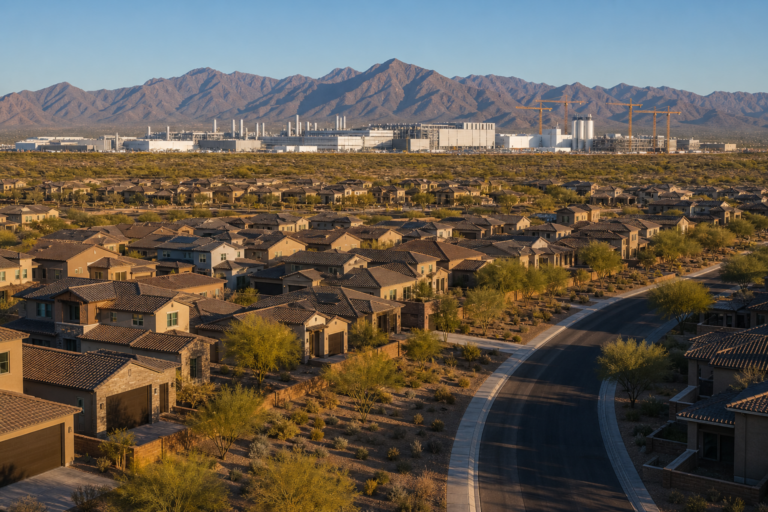
TSMC’s North Phoenix campus is over 1,000 acres. Six fabrication plants, two advanced packaging facilities, and a full R&D center. The total investment across TSMC, Intel, and their supplier network in Arizona has crossed $165 billion in announced facilities between 2020 and 2025. The CHIPS Act pushed approximately $6.6 billion into Arizona projects, with roughly $4 billion going to Intel in Chandler alone.
The Phoenix metro now ranks fourth nationally in semiconductor employment with over 24,000 workers, a 22% increase since 2017. And every semiconductor job supports five additional positions in construction, retail, and services. Real Estate Daily News
Five to one. Think about that from an investment standpoint.
At a recent industry summit, one developer compared what’s happening in North Phoenix right now to what happened in Chandler after Intel opened there in 1980. Chandler was agricultural land. Then one investment created momentum that turned the whole city into a leading tech hub. “If you think back to what Chandler was in the 1970s and then what it ultimately is today, that’s effectively what’s going to happen north of the 101,” he said. Bisnow
That’s not hype. That’s history repeating itself one freeway north.
Phoenix’s semiconductor ecosystem now includes 35 major manufacturers and 181 suppliers. Real Estate Daily News These aren’t companies that picked Arizona on a whim. They’re here because the infrastructure, the workforce pipeline, and the business environment make it the right call. And they’re not leaving.
Chandler: The Market That Already Proved the Model
19% of employment in Chandler is in advanced manufacturing, while the rest of the region sits around 4%. AZ Big Media Intel, NXP, Microchip Technology, Wells Fargo, Bank of America, Northrop Grumman. These aren’t tenants that leave when the market softens. They’re anchors.
Chandler holds an AAA bond rating from all three rating agencies. There are about 20,000 towns in America and only a few dozen have that distinction. What that tells you as an investor is that this city manages money well and plans long term. It’s not an accident that it keeps attracting major employers.
The median home price in Chandler is running in the $524,000 to $550,000 range as of early 2026 depending on the source and month. Homes are closing at around 98% of asking price. That’s not a soft market. That’s a stable one with real underlying demand.
If you want a rental property with a tenant base of engineers, tech professionals, and finance workers with household incomes well above the metro average, Chandler is still one of the best setups in the Valley. The existing companies serve as the core of the gravity, and as semiconductors become increasingly important to national and economic security, Chandler will continue to benefit. AZ Big Media
Mesa: The One Investors Are Still Underpricing
Mesa is the most interesting market in the East Valley right now and most people outside of it haven’t fully caught on yet.
Mesa is deepening its role in the global chip supply chain with new facilities, and Hadrian has opened a precision manufacturing facility supporting aerospace and defense production. Theravenscroftgroup EdgeCore finalized 44 acres for a major data center campus expansion, further cementing Mesa as a rising force in digital infrastructure.
And then there’s Meta.
Meta’s 2.5 million square foot data center in Mesa is among the largest in the country. The facility is powered by 100% renewable energy through a partnership with Salt River Project, which is bringing 450 megawatts of new solar energy to the Arizona grid. AZ Big Media That’s not a side project. That’s a billion dollar plus infrastructure commitment to Mesa specifically.
The median home price in Mesa is in the $435,000 to $480,000 range as of early 2026. That’s $70,000 to $115,000 below Chandler for comparable product. The employment base driving demand is essentially the same corridor of companies.
ASU’s Polytechnic campus in Mesa is on a growth path toward becoming one of the premier engineering and technology programs in the Southwest, which creates a built in renter pool that doesn’t evaporate. Downtown Mesa is actively transforming, with roughly 1,500 new homes added to the core in recent years and over 4% of the city designated for active redevelopment. Light rail connects directly to Tempe and ASU.
The infrastructure is there. The pricing hasn’t fully caught up yet. That gap is where investors make money.
The Data Center and AI Infrastructure Play
This is the angle most real estate investors aren’t talking about yet and they should be.
Virginia, Texas, and Arizona alone make up 2 gigawatts of the 15 gigawatts of national data center power capacity currently planned or under construction. Forvis Mazars Arizona is one of three states leading the country in this buildout.
Data centers are not just tech projects. They’re economic anchors. They employ construction workers for years during the build phase, then permanent operations staff, then pull in supporting businesses, restaurants, and housing demand from their workforce.
The pace of large load facility construction in Arizona is exceeding historical growth patterns and challenging how utilities plan investments. The Mesa Tribune That’s a signal. When the grid is struggling to keep up with demand, you’re not in a market that’s slowing down.
Mesa’s position at the center of this is not a coincidence. The city has the infrastructure, the land, the fiber connectivity, and the proximity to Phoenix Mesa Gateway Airport that makes it attractive for companies that need reliable power and logistics access. EdgeCore, Meta, and others chose Mesa for specific reasons. Investors should be paying attention to the same ones.
The Price Road Corridor: One of the Strongest Employment Spines in the Southwest
Draw a line north to south along Price Road from Scottsdale through Chandler and you’re cutting through one of the densest concentrations of high wage employment in the entire Southwest.
Intel. TSMC suppliers. Microchip Technology. Corporate campuses for Wells Fargo and Bank of America. The neighborhoods within a reasonable commute of this corridor consistently outperform the surrounding market on both days on market and price per square foot.
Think Ocotillo, Fulton Ranch, parts of Gilbert along the 202. These aren’t random pockets of demand. They’re being pulled by the employment spine running right up the middle of them.
Buy near where people work. Not a revolutionary idea. But a lot of investors still ignore it and wonder why their vacancy rates are higher than their neighbor’s.
Bioscience and Healthcare: The Sector Nobody’s Talking About
Everyone’s focused on semiconductors. Understandably. But bioscience in Arizona is quietly putting up serious numbers and it’s one of the most stable economic drivers you can have in a market.
Phoenix Mayor Kate Gallego has highlighted nearly $7 billion in bioscience capital investments since taking office, more than 8 million square feet in primary facilities, and upwards of 14,000 new jobs in the sector. Rise48 Equity
Arizona universities have set records in R&D spending at over $800 million and NIH grant funding at $368 million. Nonhospital bioscience jobs grew 19% between 2020 and 2023. Rise48 Equity
Banner Health recently broke ground on a $400 million medical campus in Scottsdale. Healthcare jobs don’t get outsourced. They don’t disappear when a tech cycle cools off. They’re one of the most durable demand drivers for housing in any market, and the East Valley is building out its healthcare infrastructure in a serious way.
If I’m being honest, this is the sector most investors are completely ignoring while chasing the semiconductor story. Both matter. The bioscience angle is just less crowded right now.
What the Numbers Say About Arizona’s Trajectory
Arizona’s job growth is forecast to accelerate from roughly 0.8% in 2025 to around 1.6% in 2026, with personal income growth expected to rise toward 5.7%. Eller College of Management That’s the Eller College forecast and it lines up with what the employment data on the ground is showing. Rising incomes support rising rents. Rising rents support your underwriting.
Arizona’s year over year job growth is outpacing the national average at 1.01% versus 0.83%. Rise48 Equity Not blowout numbers, but consistent. And consistency in a market you’re holding for five to ten years matters more than a single hot year.
Phoenix added nearly 55,000 people last year. Those people need somewhere to live.
Where I’d Be Looking Right Now
Here’s how I actually think about where to invest in the Phoenix metro in 2026, both as an agent and as someone who looks at these deals the same way my clients do.
East Mesa near the Gateway Airport corridor for long term rentals. The semiconductor supply chain, data center buildout, and aerospace manufacturing presence create a durable tenant base that most people haven’t priced in yet.
Chandler near the Price Road employment spine for appreciation and quality tenants. You’re paying a premium compared to Mesa but you’re also getting the most battle tested employment anchor in the East Valley.
Gilbert for move up buyer demand. If you’re buying a property that benefits from a strong resale market, Gilbert’s school districts and master planned communities consistently attract buyers willing to pay. Low days on market, strong price per square foot.
Downtown Mesa for anyone with a longer horizon and an appetite for emerging market upside. The city is putting real money into this transformation. The investors who get in before it’s obvious always look the smartest in retrospect.
The investors I see missing right now are waiting for a perfect entry point while the job announcements keep coming and the population keeps growing. There’s no bell that rings at the bottom of an emerging market. You either see what’s being built and position ahead of it, or you read about it later and wonder why you waited.
If you want to talk through what actually makes sense for your situation, budget, and goals in the East Valley, let’s get on a call. I work with investors across Mesa, Chandler, Gilbert, and Scottsdale on everything from single family rentals to creative finance structures and I’m happy to walk through the real numbers with you.
Call or text: (602) 935 6959 Email: Robbie@RJHHomesteam.com rjhhomesteam.com
Robbie Holycross is the founder of RJH Homes and has been working with buyers, sellers, and investors across the East Valley for 6 years. He holds a background in finance and economics and carries an active mortgage license (NMLS 2633845), specializing in move up buyers and real estate investors throughout the greater Phoenix area.
Sources: CBRE Semiconductor Report October 2025 | Bisnow Phoenix Construction Summit March 2026 | AZ Big Media East Valley Economic Development January 2025 | Eller College of Management Arizona Economic Outlook March 2026 | Rise48 Equity Phoenix Market Updates 2025/2026 | BLS Phoenix Area Economic Summary February 2026 | Meta Data Centers Mesa Arizona 2025 | Arizona Technology Council February 2025
Phoenix Metro Investment Markets Comparison: 2026
| Area | Median Price | Avg Rent (3BR) | Est. Cap Rate | Growth Driver |
|---|---|---|---|---|
| Mesa | ~$430K | ~$1,900 | 4.5-5.5% | Affordability, ASU Poly, Boeing |
| Gilbert | ~$520K | ~$2,200 | 3.5-4.5% | Schools, families, tech jobs |
| Chandler | ~$510K | ~$2,100 | 3.8-4.5% | Intel, Price Road tech corridor |
| Queen Creek | ~$480K | ~$2,000 | 4.0-5.0% | New construction, rapid growth |
| Tempe | ~$460K | ~$2,100 | 4.5-5.5% | ASU, light rail, rental demand |
| Phoenix (central) | ~$380K | ~$1,800 | 5.0-6.0% | Affordability, revitalization |
| Scottsdale | ~$780K | ~$2,800 | 3.0-4.0% | Appreciation play, luxury market |
Sources: Zillow Rental Manager, Redfin Phoenix Metro, Arizona Regional MLS
Frequently Asked Questions About Real Estate Investing in Phoenix
Keep Reading
If you found this helpful, check out these related articles:
- Phoenix Market Update: June 2026
- Is Now a Good Time to Buy in Phoenix?
- Arizona Neighborhoods Before Buying
- New Construction vs Resale in Phoenix
Is Phoenix a good real estate investment in 2026?
Phoenix remains one of the top real estate investment markets in the country in 2026.
Phoenix remains one of the top real estate investment markets in the country in 2026. The fundamentals that drive real estate value — population growth, job creation, limited land in desirable areas, and relative affordability compared to coastal cities — are all still intact. Maricopa County added over 50,000 new residents in the past year, and major employers like TSMC, Intel, Taiwan Semiconductor, and multiple data center operators continue expanding. The market has normalized after the 2020-2022 frenzy, which actually creates better opportunities for investors who can buy at rational prices instead of overpaying in bidding wars.
What type of investment property is best in Phoenix?
The best investment strategy depends on your goals: Single-family rentals — lowest risk, strong appreciation, best for long-term hold.
The best investment strategy depends on your goals:
- Single-family rentals — lowest risk, strong appreciation, best for long-term hold. Ideal in Mesa, Gilbert, Chandler, and Queen Creek where family renters are abundant
- Small multifamily (2-4 units) — higher cash flow, better cap rates. Best opportunities in central Phoenix and older Tempe neighborhoods
- Short-term rentals (Airbnb) — highest potential income but more management intensive. Best near Scottsdale Old Town, Tempe Town Lake, or spring training stadiums
- New construction — lower maintenance, builder warranties, higher rents. Available in Queen Creek, Buckeye, and south Mesa
Most first-time investors do best with a single-family rental in a strong school district — it attracts stable, long-term tenants and appreciates consistently.
What cap rate should I expect in the Phoenix metro?
Cap rates in the Phoenix metro range from 3% in premium Scottsdale locations to 6%+ in central Phoenix and outlying areas.
Cap rates in the Phoenix metro range from 3% in premium Scottsdale locations to 6%+ in central Phoenix and outlying areas. A realistic target for a well-located single-family rental in the $400K-$500K range is 4-5%. Keep in mind that Phoenix investors often prioritize appreciation over cash flow — a property with a 4% cap rate that appreciates 5% annually delivers a 9% total return. Markets like Mesa and Tempe offer the best balance of cash flow and appreciation potential in 2026.
Should I invest in Phoenix or another market?
Phoenix outperforms most competing sunbelt markets on a risk-adjusted basis.
Phoenix outperforms most competing sunbelt markets on a risk-adjusted basis. Compared to Austin, Phoenix has more stable pricing and stronger population growth. Compared to Tampa, Phoenix has lower insurance costs and no hurricane risk. Compared to Nashville or Charlotte, Phoenix offers more affordable entry points and stronger rental demand. The key Phoenix advantage is its economic diversification — the metro isn’t dependent on any single industry, which protects investors during economic downturns. The main risk is water supply perception, but the Valley’s water infrastructure is more robust than headlines suggest.
What areas of Phoenix should investors avoid?
Avoid areas with stagnant or declining population trends, high vacancy rates, and weak employment.
Avoid areas with stagnant or declining population trends, high vacancy rates, and weak employment. Specifically, be cautious about far-flung suburban developments where builders are offering aggressive incentives — that often signals oversupply. Some areas of south Phoenix and west Mesa have higher crime rates that can impact tenant quality and turnover costs. Also be wary of short-term rental investments in cities that have enacted or are considering STR restrictions. Always run the numbers on a specific property rather than making blanket assumptions about an entire zip code.