
New Construction vs Resale in Phoenix: How to Actually Decide in 2026
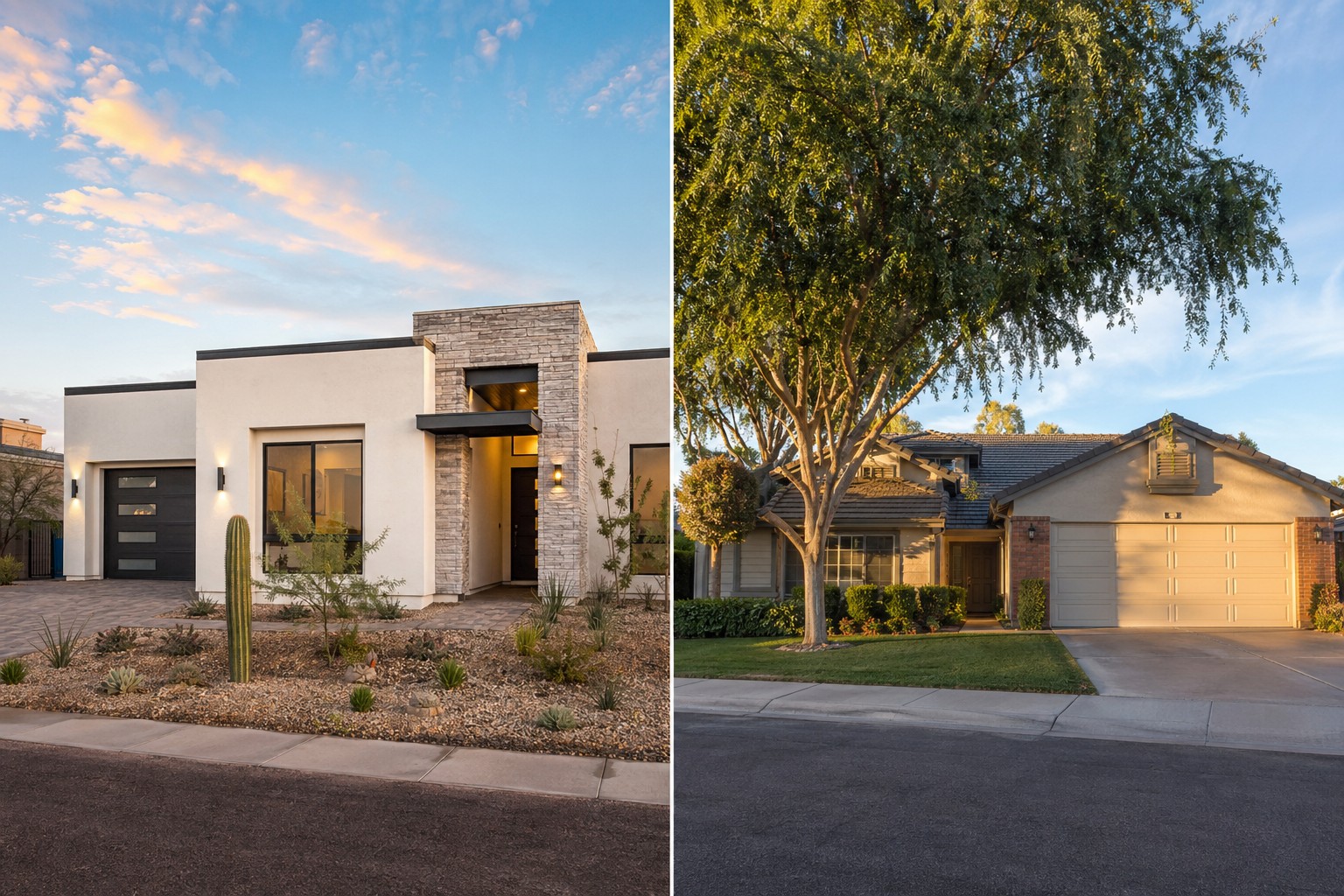
When it comes to new construction vs resale in the East Valley, this is one of the most common conversations I have with buyers right now and honestly it’s one of the ones I enjoy most because there’s no universal right answer.
New construction versus resale comes down to your goals, your timeline, and what you actually want your life to look like in that home. Anyone telling you one is always better than the other is either uninformed or trying to steer you somewhere for their own reasons.
Let me give you the real breakdown.
The New Construction vs Resale Question Everyone Gets Wrong in the East Valley
The number one objection I hear from buyers who are hesitant about new construction is build quality. “I heard they don’t build them like they used to.” “The materials are cheaper.” “My neighbor had nothing but problems.”
Here’s the thing. There’s some truth to it and also a lot of myth wrapped around it.
Yes, some builders cut corners. Yes, some materials have changed over the years. But here’s what most people don’t realize: whether you’re buying a $300,000 starter home or a $4 million custom build in Scottsdale, the contractors actually swinging the hammers and laying the floors are often the same people. What changes is the materials specified, the supervision on site, and the construction manager running the show.
That last part matters more than anything else. A great construction manager with average materials will outperform a bad one with premium materials every single time. This is true across every builder in the Valley regardless of their reputation or price point.
So what do you do with that information? You get a good inspector in your corner. Not the builder’s inspector. Your own independent inspector who is there to protect you and no one else. I have people I trust for this and I put them on every new build deal I’m involved in. It’s not optional.
What Builders Are Offering Right Now
In a slower market, builders have tools that resale sellers simply don’t have. And right now they’re using them.
Rate buydowns are the big one. Builders can buy down your interest rate through their preferred lender in ways that a private seller just can’t match. A 1% to 2% rate reduction on a $500,000 home is real money every single month for the life of that loan. I’ve seen buyers save $400 to $600 a month compared to what they’d pay on a comparable resale at market rate.
On top of that you’re seeing closing cost credits, free upgrades on finishes, lot premiums being waived, and in some communities extended price locks while the home is being built.
If you’re buying right now and you’re not at least looking at what builders are offering, you’re potentially leaving a significant amount of money on the table. The incentive environment today is genuinely good for buyers and it won’t last forever. When the market tightens back up those incentives disappear fast.
The Trade Off Nobody Talks About: Location
Here’s where I’ll be straight with you. New construction almost always means you’re trading location for newness.
The established neighborhoods in Gilbert, Chandler, and Scottsdale where you want to be don’t have open lots sitting around waiting for a builder to put up 200 homes. So new construction pushes out. Queen Creek, far east Mesa, parts of San Tan Valley. These are great communities being built well, but you need to be honest with yourself about the commute, the distance from the things you use daily, and what that trade off actually costs you in time and quality of life.
The flip side of this that I always share with buyers is a longer view. The areas that feel remote today are not going to feel remote in ten years. I’ve watched this play out repeatedly in the East Valley. Gilbert felt far out to people in the early 2000s. Chandler before that. The Valley grows south and east and the places that seem like the edge of civilization right now are going to be central in a decade.
So if you’re buying with a five to ten year horizon and you can handle the current commute, buying new in an emerging area is often a very smart long term play. If you’re buying for right now and location is everything, resale in an established area probably wins.
The Hidden Cost of Resale Nobody Budgets For
Resale homes have their own traps and buyers walk into them constantly.
A home that’s ten, fifteen, or twenty years old comes with ten, fifteen, or twenty years of wear. The roof has a remaining life. The HVAC is on a clock. The water heater, the appliances, the pool equipment if there is one. These things don’t all fail on day one but they fail and when they do they’re expensive.
I’ve watched buyers stretch their budget to get into a resale home in the location they wanted and then get hit with a $15,000 HVAC replacement and a $12,000 roof in the first three years. That’s not bad luck. That’s just the reality of an aging home that wasn’t properly accounted for in the purchase decision.
Before you buy a resale home you need a thorough inspection, a sewer scope, and an honest conversation about what the deferred maintenance situation looks like and what it’s going to cost you. Factor that into your offer. A good agent uses that information in negotiations.
This is also where the comparison to new construction shifts. Yes, new builds cost more per square foot in a lot of cases. But you’re also buying yourself several years of minimal maintenance costs and a builder warranty. That has real dollar value that doesn’t show up in the list price comparison.
So Which One Is Right for You?
The new construction vs resale decision comes down to a few key questions. Ask yourself these.
How long are you planning to stay? Shorter horizon favors established areas with stronger resale demand. Longer horizon opens up emerging new build communities with more upside.
How important is location right now versus ten years from now? If you need to be central today, resale probably wins. If you can play the long game, new build areas look very different in a decade.
What’s your appetite for maintenance and updates? If you want to move in and not think about the house for five years, new construction has a real advantage. If you love projects and want to put your own stamp on a home, resale gives you that canvas.
What does the financing look like? Right now builder incentives are strong enough that the financing math on new construction is genuinely competitive. Run both scenarios with real numbers before you decide.
At the end of the day the new construction vs resale decision is completely situational. There’s no wrong answer if you’re making it with clear eyes and the right information. What I do for every buyer I work with is walk through both options side by side with real numbers so you can see exactly what you’re trading off before you commit.
If you’re in the East Valley and trying to figure out which path makes more sense for your situation, let’s talk. I work with buyers on both new construction and resale across Gilbert, Mesa, Chandler, Scottsdale, and Queen Creek and I’m happy to walk through the numbers with you.
Call or text: (602) 935-6959
Email: Robbie@RJHHomesteam.com
rjhhomesteam.com
Robbie Holycross is the founder of RJH Homes and has been working with buyers, sellers, and investors across the East Valley for 6 years. He holds a background in finance and economics and carries an active mortgage license (NMLS 2633845), specializing in move-up buyers and real estate investors throughout the greater Phoenix area.
New Construction vs. Resale: Side-by-Side Comparison
| Factor | New Construction | Resale Home |
|---|---|---|
| Median Price (Phoenix Metro) | $450K-$550K | $400K-$480K |
| Customization | Choose finishes, floor plan options | What you see is what you get |
| Maintenance (First 5 Years) | Minimal — everything new + warranty | Budget $2,000-$5,000/year |
| Energy Efficiency | Modern insulation, dual-pane windows, new HVAC | Varies — older homes cost more to cool |
| Yard/Landscaping | Usually bare — budget $5K-$15K | Mature trees, established landscaping |
| Move-In Timeline | 4-8 months (if under construction) | 30-45 days |
| Negotiation Room | Limited on price, flexible on upgrades | More room on price, repairs, closing costs |
| Location Options | Edge of metro (Queen Creek, Buckeye, Surprise) | Established areas (Chandler, Mesa, Scottsdale) |
Sources: National Association of Home Builders, Zillow Phoenix New Construction, Arizona Registrar of Contractors
Frequently Asked Questions About New Construction vs Resale
Keep Reading
If you found this helpful, check out these related articles:
- Buying New Construction in Phoenix
- How to Buy Your First Home in Phoenix
- Hidden Costs of Buying a Home in Arizona
- Is Now a Good Time to Buy in Phoenix?
Is it cheaper to buy new construction or a resale home in Phoenix?
The sticker price on new construction in the Phoenix metro is typically 5-15% higher than comparable resale homes, but the total cost of ownership can be lower.
The sticker price on new construction in the Phoenix metro is typically 5-15% higher than comparable resale homes, but the total cost of ownership can be lower. New homes come with builder warranties (typically 1-2 years full, 10 years structural), modern energy-efficient features that reduce utility bills by $100-$200/month, and minimal maintenance needs for the first 5-7 years. Resale homes may have a lower purchase price but often need immediate or near-term investments in roofing, HVAC, water heaters, or cosmetic updates. Run the 5-year total cost — not just the sticker price — when comparing.
What upgrades are worth paying for in a new construction home?
Focus your upgrade budget on structural and mechanical items you can’t easily change later: Electrical upgrades (extra outlets, prewired for ceiling fans, EV charger).
Focus your upgrade budget on structural and mechanical items you can’t easily change later:
- Electrical upgrades (extra outlets, prewired for ceiling fans, EV charger) — $500-$2,000
- Plumbing rough-ins (future bathroom, water softener loop) — $300-$1,000
- Upgraded insulation and windows — pays for itself in AZ summers
- Garage upgrades (3-car, extended length) — hard to add later
- Lot premium (corner lot, no neighbor behind) — the only upgrade you truly can’t change
Avoid overspending on cosmetic upgrades like premium countertops, upgraded cabinets, and fancy fixtures through the builder — they charge 30-50% markups. Buy the base finishes and hire your own contractor after closing to upgrade kitchen and bathrooms at a fraction of the builder’s price.
Should I use the builder’s lender or my own?
Always get quotes from both.
Always get quotes from both. Builders often offer incentives ($5,000-$20,000 in closing cost credits or rate buy-downs) for using their preferred lender, which can make their offer competitive even if the base rate is higher. However, the builder’s lender works for the builder — their priority is closing the deal on the builder’s timeline. Get a competing quote from an independent lender, compare the total loan cost (not just the rate), and use the competing quote to negotiate. In many cases, telling the builder’s lender you have a better outside offer results in them matching or beating it to keep the incentives in play.
How long does it take to build a new construction home in Phoenix?
Typical build times in the Phoenix metro range from 4-8 months for production homes (tract builders like Meritage, Lennar, KB Home) to 12-18 months for semi-custom or custom homes.
Typical build times in the Phoenix metro range from 4-8 months for production homes (tract builders like Meritage, Lennar, KB Home) to 12-18 months for semi-custom or custom homes. Delays can add 2-4 months depending on permit processing, material availability, and weather. If you need to move quickly, look for builder inventory homes or “quick move-in” homes that are already under construction or completed — these can close in 30-60 days and sometimes come with discounted pricing since builders want them off their books.
What are the hidden costs of buying new construction?
Costs that surprise new construction buyers in Arizona include: Landscaping.
Costs that surprise new construction buyers in Arizona include:
- Landscaping — new homes come with bare dirt yards; budget $5,000-$15,000 for front and back
- Window coverings — blinds and shutters for a typical home run $3,000-$8,000
- Appliances — some builders include basic appliances, others don’t; clarify before signing
- HOA fees — new communities often have higher HOAs ($150-$300/month) due to new amenities
- Mello-Roos / Community Facilities Districts — some new developments have special tax assessments that add $1,000-$3,000/year to your property tax bill
- Extended commute — most new construction is on the metro’s edges, adding commute time and gas costs