
Remote Work and Phoenix Real Estate: Best Cities for Work-From-Home Buyers
I have sold homes to a lot of people who no longer drive to work. Software engineers still on a Seattle payroll. Insurance underwriters logging in from a spare bedroom in Gilbert. Recruiters, consultants, medical coders, sales reps with a national territory. When your commute is twelve steps down the hallway, the whole logic of picking a house changes — and most buyers do not realize how much until they are already under contract on a home that fights them every workday.
This is the guide I wish existed for those clients. It covers which cities in the Valley actually work for work-from-home buyers, what the internet situation really looks like address by address, what a home office needs to have (and what it does not), how Arizona’s tax picture changes your take-home if you keep a coastal salary, and where the honest tradeoffs are. Numbers are current as of September 2026 and every one of them is sourced.
Remote work is not a niche in Phoenix — it is a structural part of the market
Metro Phoenix has been over-indexed on remote work for years. The Phoenix-Mesa-Chandler metro ranked 10th nationally for share of remote workers, at 19.4% of the workforce in 2023, against a national rate of 13.8% — and the metro started the prior decade at just 6.1%, peaking at 23.4% in 2021 (AZ Big Media / CoworkingMag analysis of Census data). Nationally the count has come down since — from 27.6 million work-from-home employees in 2021 to about 22.1 million in 2024, with the sharpest declines in Bay Area metros (Social Explorer, 2024 ACS).
Read those two facts together and you get the thing I see on the ground: fewer people are fully remote than in 2021, but the ones who still are have gotten pickier and more mobile. They are the buyers who can choose a city on lifestyle instead of drive time. That is a real advantage, and it is worth spending it deliberately.
What each city actually costs right now
Before lifestyle, price. Here is where the Valley sits on closed single-family sales as of the most recent reporting. I have listed the source per row on purpose, because city-level numbers come from different reports with slightly different date windows, and anyone showing you one clean list without that caveat is smoothing over it.
| Area | Median single-family sale price | Notes / source |
|---|---|---|
| Phoenix metro (all ARMLS) | $450,000 | July 2026, unchanged from June, +2.3% YoY — ARMLS data via NhanceData |
| Phoenix (city, single-family) | $485,000 | +2.1% YoY — Phoenix REALTORS® / ShowingTime |
| Scottsdale | $1,250,000 | +10.6% YoY, 90 days on market — ARMLS / Phoenix REALTORS® Local Market Update, July 2026 |
| Gilbert | $600,000 | +0.2% YoY, 62 days on market — same source |
| Chandler | $553,000 | -3.8% YoY, 62 days on market — same source |
| Tempe | $530,000 | Monthly median, August 2026 — Cromford® daily data summary |
| Mesa | ~$498,000 | +1.6% YoY, 63 days on market, July 2026 third-party MLS recap — source; MLS-listed-only medians run lower |
Two things matter here for a remote buyer. First, the spread between Chandler and Scottsdale is roughly $700,000 for houses that are frequently the same size — you are paying for location, and if you never commute, you should be very clear about what that location is buying you. Second, days on market in the 60–90 day range means you have negotiating room. Sellers are getting about 97.3% of list price metro-wide (August 2026 market summary), and I have written before about how the real opportunity in this market is in the negotiation, not the sticker price.
The internet question: fiber has quietly become the deciding factor
If you take one thing from this article, take this: check the internet at the specific address before you write the offer, not the city. Availability changes street by street in the Valley, especially in older neighborhoods surrounded by newer builds.
The good news is that the metro is unusually well served. Phoenix has fiber available from three providers with roughly 81% fiber coverage, against a national average near 57% (Internet Providers, 2026). Google Fiber started building in Maricopa County in 2023, connecting Mesa first, and has prioritized Mesa, Gilbert and Chandler because of growth and new residential construction (Google Fiber Arizona coverage summary).
| Plan | Speed (down / up) | Price | Good for |
|---|---|---|---|
| GFiber Core 1 Gig | 1,000 / 1,000 Mbps | $70/mo | One or two remote workers, video calls, streaming |
| GFiber Home 3 Gig | 3,000 / 3,000 Mbps | $100/mo | Content creators, large uploads, big households |
| GFiber Edge 8 Gig | 8,000 / 8,000 Mbps | $150/mo | Overkill for almost everyone, honestly |
Prices and tiers per Google Fiber’s Chandler page (installation, Wi-Fi and unlimited data included; typical latency around 13 ms). Cox remains the coverage leader in Phoenix at roughly 81% reach and has accelerated its own fiber upgrades in response, with CenturyLink close behind on footprint. What symmetrical fiber actually buys a remote worker is upload speed — the thing that makes screen sharing, large file pushes and two simultaneous video calls in one house stop being a daily argument.
My practical checklist before you remove the inspection contingency:
- Run the address (not the ZIP) through each provider’s availability tool, and through the FCC-data-based broadband map as a cross-check.
- Ask the seller which provider they use and what they actually pay. Sellers answer this honestly more often than you would expect.
- Look for a structured wiring panel or Cat6 drops. In homes built after roughly 2015 in Gilbert, Chandler and Queen Creek these are common; in 1990s Scottsdale and Tempe they are not.
- If the house is on 5G home internet only, treat that as a real limitation for calls, not a technicality.
- Have a backup plan. A cheap second line or a hotspot plan is the difference between a bad afternoon and a lost client.
The best Valley cities for work-from-home buyers
There is no single best city. There is a best city for how you actually spend a Tuesday. Here is how I’d sort it.
Chandler — the value pick for tech-adjacent remote workers
Chandler is where I send remote buyers who want new-ish construction, dense fiber coverage, real coworking options and a median that came down 3.8% year over year while everything around it held flat. The tech corridor south of the 202 has the newest housing stock and the most consistent fiber. If you occasionally have to sit in an office — a hybrid pattern that is now more common than fully remote — Chandler puts you inside reach of the big semiconductor and services employers without paying Scottsdale prices. I covered the broader employer shift in how TSMC and Intel are reshaping Phoenix real estate.
Gilbert — best for remote parents
Gilbert holds its value ($600,000 median, essentially flat year over year) and its housing stock is heavy on the exact floor plans remote workers need: four or five bedrooms, a flex room or den off the entry, and often a casita. Working from home with kids in the house is a floor plan problem before it is a discipline problem, and Gilbert’s inventory solves it more often than anywhere else in the Valley. Start with my Gilbert neighborhood guide for families.
Tempe — best for people who need to leave the house
At a $530,000 median, Tempe is not cheap for what you get in square footage, but it is walkable in places, dense with coffee shops and third spaces, and has genuine energy. If working alone in a quiet subdivision makes you miserable — and for a lot of people it does after about six months — Tempe is the antidote. See living in Tempe for the honest version, including the noise and rental-density tradeoffs.
Mesa and Queen Creek — best price per square foot for a dedicated office
If your requirement is simply “one room with a door that is not a bedroom,” this is where your dollar goes furthest. Mesa’s median sits near $498,000 with 63 days on market, and Google Fiber landed in Mesa before anywhere else in the county. Queen Creek keeps building the newest stock in the metro — go read my Queen Creek buyer’s guide and be honest with yourself about drive times to the airport if you travel for work.
Scottsdale and Arcadia — best if the salary is coastal and the lifestyle is the point
At a $1.25M median, up 10.6% year over year, Scottsdale is the one city in this list where remote buyers are the marginal price setter. People arriving with California or Washington equity and no commute obligation have bid this market up, and the 90-day average marketing time tells you the buyer pool at that price is thin and picky. It is a legitimate choice if you want trails out the door, a real dining scene and resale strength. Start with best neighborhoods in Scottsdale or Arcadia if you want mature trees and older character.
What a real home office needs (and what buyers overpay for)
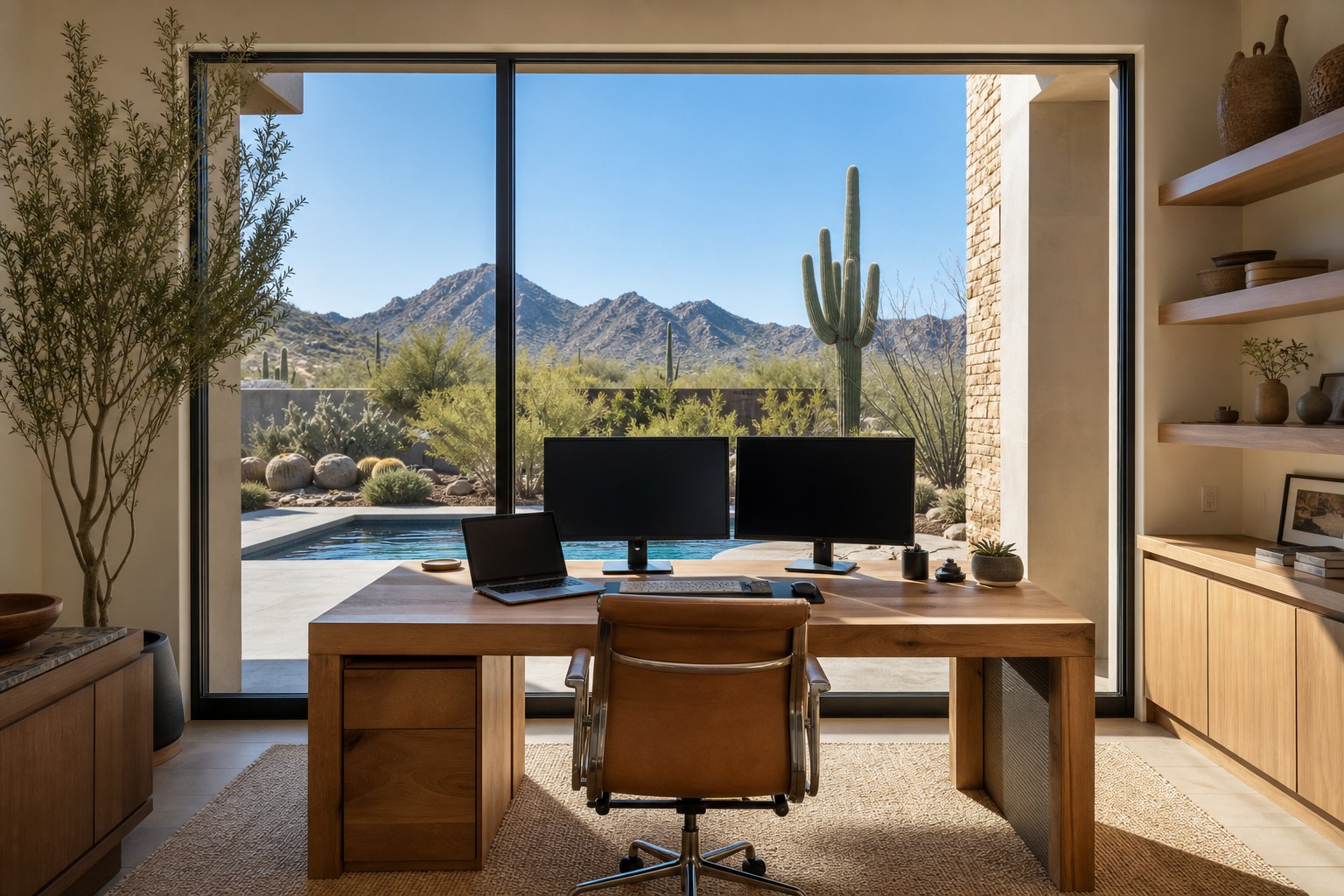
After walking hundreds of homes with remote buyers, the features that actually matter are boring:
- A door. Not a nook, not a loft. A door that closes on a call.
- A window that does not face west. A west-facing office in Arizona is a 4 p.m. problem 300 days a year — heat load and glare on the camera. North-facing is the prize.
- A separate HVAC zone or at least a return in the room. A converted den on a single-zone system will run 8–10 degrees off the rest of the house in July.
- Electrical capacity and a grounded circuit you are not sharing with the kitchen. Two monitors, a dock, a printer and a space heater in January add up.
- Distance from the laundry room and the front door. Doorbell and dryer are the two most common call-ruiners.
What people overpay for: built-in cabinetry marketed as an “executive office,” and casitas. A casita is a wonderful thing, and it is also frequently a $60,000–$120,000 premium for a room you could get inside the main house for a fraction of that. Buy the casita if you want guests, rental income, or a parent moving in — not because you need a desk. And if you are eyeing new construction because the model home’s office looked perfect, read what the builder won’t tell you first: office and flex-room upgrades are among the highest-margin options on the sheet.
Coworking: the pressure valve nobody budgets for
Roughly a third of my remote-work clients end up buying some form of out-of-house workspace within the first year. Budget for it before you stretch your purchase price to the top of your approval. Current published rates around the Valley:
| Space | Location | Option | Published rate |
|---|---|---|---|
| The Works | Gilbert (S. Higley Rd) | Day pass / dedicated desk | $29 per day / $250–$295 mo |
| Workuity | Chandler (Frye Rd) | Open coworking / dedicated desk | From $215 / from $350 mo |
| Workuity | Phoenix (24th & Camelback) | 24/7 coworking / private office | From $259 mo / from $600 mo |
| Kiln | Gilbert | Club (shared) / Resident desk | $395 / $550 mo |
Rates as published on each operator’s site, September 2026; most are 12-month rates and month-to-month runs higher. Note the pattern — a virtual office with a business address is $55–$64/month at several operators, which is the cheapest way to keep your home address off your LLC paperwork.
The tax math on keeping a coastal salary
This is the part where the numbers get big enough to matter, and also the part where I have to tell you I am a REALTOR® and not a CPA. Talk to one before you move — but understand the shape of it.
Arizona has a flat 2.5% state income tax and no local or municipal income taxes anywhere in the state (A.R.S. § 43-1011; Arizona Department of Revenue notes there are no bracket tables for 2023 and beyond because of the flat rate). Here is what that looks like against the states most of my relocating clients come from.
| State | Top marginal state income tax rate, 2026 | Structure |
|---|---|---|
| Arizona | 2.5% | Flat, no local income tax |
| California | 13.3% (12.3% + 1% surcharge over $1M) | Graduated — highest in the country |
| Oregon | 9.9% | Graduated |
| Washington | 0% on wages | No wage income tax; 7% capital gains tax above the annual threshold |
| Colorado | 4.4% | Flat |
Rates per Visual Capitalist’s 2026 state rate map and California FTB 2026 brackets. On a $200,000 household income, the California-to-Arizona swing is real money every year — often more than the annual cost of the pool everyone worries about.
Three things that trip people up:
- Your employer’s address does not decide anything. What matters is your residency and where you physically perform the work. Arizona is not a “convenience of the employer” state, and neither is California — those rules live in places like New York.
- You have to actually break residency. California audits departures aggressively. If you keep a home, register cars, and spend half the year there, you have not moved for tax purposes no matter what your driver’s license says. Document the move.
- Part-year years are messy. The year you relocate, expect to file in both states and prorate. That is normal, not a red flag.
For the broader relocation picture, including what genuinely gets cheaper and what does not, see moving from California to Arizona and my cost of living in Phoenix breakdown.
The cost-of-living advantage is real — just smaller than the internet says
Every relocation calculator gives you a different answer, and the spread is embarrassing. Comparing Phoenix to San Francisco: Numbeo puts cost of living including rent 49.4% higher in San Francisco, with rents 100.2% higher (Numbeo, June 2026). Salary.com says living in San Francisco is 72.7% more expensive, while noting SF employers pay about 26.3% more for the same role (Salary.com, June 2026). Expatistan lands at Phoenix being 34% cheaper overall (Expatistan, June 2026).
Those are not the same claim, and you should not plan around any one of them. What all three agree on is the mechanism: housing is the whole story, and the second-biggest line is transportation. Everything else — groceries, restaurants, healthcare — is closer than people expect, and Arizona utilities in summer are genuinely higher than coastal California’s. Expatistan has Phoenix utilities running about 33% above San Francisco for a comparable unit. Your July power bill will surprise you once.
So if you are arriving on a coastal salary with a remote job, the honest framing is: you are converting a housing-cost advantage and a tax advantage into square footage, a dedicated office, and probably a pool. You are not going to cut your total spending in half. And plan for the costs that do not show up on any calculator — I listed them in hidden costs of buying a home in Arizona.
The honest downsides
I would rather you hear these from me than discover them in your second summer.
- Summer isolation is real. Between June and September you are not walking anywhere at 2 p.m. If your entire social structure was your office, working from home in a Phoenix summer can get very small very fast.
- Time zones cut both ways. Arizona does not observe daylight saving. For half the year you match Pacific time, for the other half you match Mountain. If your team is on the East Coast, plan on early starts year-round.
- Power reliability and cooling costs matter more when you are home all day. Ask for 12 months of utility history, and get the HVAC age in writing. My Arizona home inspection guide covers what the desert actually does to a house.
- Hybrid creep. Several clients bought 45 minutes from an office they never expected to visit, and were called in twice a week eighteen months later. If there is any chance your role changes, price that commute now.
How I’d approach the search if I were you
Write down the three non-negotiables for your workday — usually a room with a door, symmetrical fiber, and a maximum drive to an airport or a possible office. Then pick two cities, not five. Then get pre-approved and negotiate hard, because at 60 to 90 days on market with sellers taking about 97% of list, this is a market where a prepared buyer gets concessions: rate buydowns, HVAC replacement, closing costs. That leverage evaporates the moment inventory tightens, and I have been watching pending sales closely for exactly that signal.
Frequently Asked Questions
Which Phoenix-area city is best for remote workers?
Chandler is the best all-around pick for remote workers thanks to dense fiber coverage, newer homes and a median single-family price of $553,000, while Gilbert is better for remote parents and Tempe is better if you need to get out of the house. Mesa and Queen Creek give you the most square footage per dollar if your only real requirement is a dedicated office with a door. Scottsdale works if you are arriving with coastal equity and buying the lifestyle, but the median there is $1.25 million.
Does Phoenix have good internet for working from home?
Yes — metro Phoenix has fiber available from three providers with roughly 81% fiber coverage, well above the national average of about 57%. Google Fiber has built aggressively across Maricopa County starting in Mesa, with 1 Gig symmetrical service at $70/month and 3 Gig at $100/month, and its arrival pushed Cox to accelerate its own fiber upgrades. Always verify at the specific street address rather than the city, because availability changes block by block.
How much does Arizona tax remote workers?
Arizona has a flat 2.5% state income tax with no local or municipal income taxes, the lowest flat rate of any income-taxing state. Compare that to a 13.3% top rate in California and 9.9% in Oregon. What matters for taxation is your residency and where you physically do the work, not your employer’s address — and if you are leaving California you need to genuinely break residency, because departures get audited.
How much should I budget for coworking space in the Phoenix area?
Plan on $200 to $400 a month for a coworking membership in the Valley, or about $29 for a single day pass. Published September 2026 rates run from $215/month for open coworking in Chandler and $250–$295 for a dedicated desk in Gilbert, up to $395–$550/month at premium Gilbert spaces and $600+ for a private office in Phoenix. Roughly a third of my remote clients add some out-of-house workspace within their first year, so budget it before you max out your purchase price.
What should I look for in a home office when buying in Arizona?
Prioritize a real room with a door that is not a bedroom, a window that does not face west, and either an HVAC zone or at least an air return in the room. A west-facing office in Arizona is a heat and glare problem most afternoons of the year, and a converted den on a single-zone system can run 8 to 10 degrees off the rest of the house in July. Also check the electrical circuit and put the office away from the laundry room and front door. Skip the $60,000–$120,000 casita premium unless you actually want guest or rental space.
Let’s talk about your actual workday
I have helped remote buyers land in Gilbert, Chandler, Mesa, Tempe, Scottsdale and Queen Creek, and the good outcomes all started the same way — a conversation about how you work, not about how many bedrooms you want. Tell me what your Tuesday looks like and I will tell you which three neighborhoods to spend a weekend in, and which listings to skip because the office faces west and the fiber stops two streets short.
Reach out to the RJH Homes Team here and let’s map it out. No pressure, no drip campaign — just a straight answer about where your remote job buys you the most house in the Valley.