
Living in Tempe AZ: More Than a College Town
Living in Tempe AZ means something completely different depending on which part of the city you are in, and that is the thing most people get wrong about Tempe before they actually spend time here. The ASU campus and Mill Avenue are the first things that come to mind when anyone mentions Tempe and both are worth knowing about. But the city stretches well beyond the university footprint into established residential neighborhoods, professional corridors, waterfront living along Tempe Town Lake, and some of the best dining and nightlife in the greater Phoenix metro. Tempe is not a college town that happens to have neighborhoods. It is a real city that happens to have a world-class university in the middle of it.
Tempe Is Not Just ASU: Understanding the Full City
This is the perception that costs buyers. People hear Tempe and picture dorm life, house parties, and transient renters. That picture is accurate for about a half-mile radius around campus. The rest of the city tells a different story.
Tempe borders Scottsdale to the east, Mesa to the east and north, Phoenix to the west, and Chandler to the south. It is one of the most centrally located cities in the entire Valley. Sky Harbor Airport is minutes away. The 101, the 202, and the 60 all run through or adjacent to Tempe. Light rail connects the city to downtown Phoenix, Mesa, and the airport corridor. For professionals who need to move around the Valley without living in a car, Tempe’s location is genuinely hard to beat.
The neighborhoods north of the university toward the lake attract young professionals, established residents, and families who want urban walkability without the density of downtown Phoenix. The neighborhoods south of campus toward Guadalupe Road tend toward single family homes with more traditional residential character and lower price points. The areas along the 101 and around the Price Road Corridor have become legitimate business and corporate hubs, with major employers, WeWork and coworking facilities, and professional services that draw a working population entirely separate from the university.
Tempe has its own identity. It just takes looking past the obvious to find it.
Mill Avenue, Tempe Town Lake, and What Makes Tempe Worth Living In
Mill Avenue is the spine of Tempe’s entertainment district and it earns its reputation. Bars, restaurants, live music venues, and retail line the street from the university north toward the lake. It is one of the few walkable entertainment corridors in a metro that is otherwise heavily car-dependent. On any given night Mill Avenue has energy that most suburban Valley cities simply cannot manufacture.
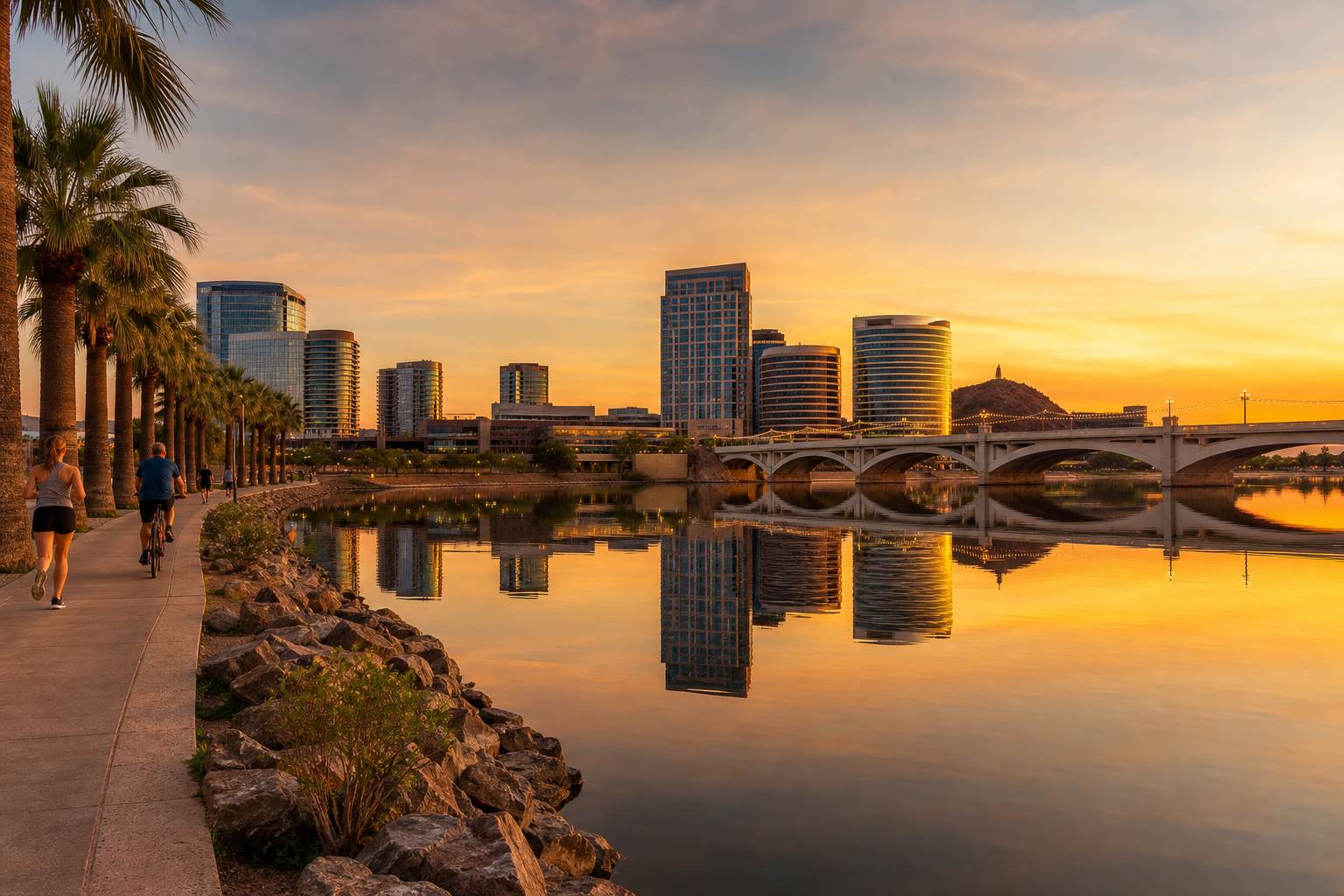
Tempe Town Lake is one of the best urban amenities in all of Phoenix. The 2-mile man-made lake along the Salt River sits in the heart of the city with a paved trail system around the perimeter, kayak and paddleboard rentals, waterfront restaurants, and views of the Tempe skyline that most people do not expect when they picture the Valley. Tempe Beach Park sits on the north shore and hosts festivals, concerts, and events throughout the year. The lake is a genuine quality of life asset that drives demand for the neighborhoods surrounding it.
The rooftop bar and pool scene in Tempe is legitimate. Hotel rooftops and upscale bar concepts along and near Mill Avenue draw a crowd well beyond the student population. If you want the energy of a city night out without driving to Scottsdale, Tempe delivers it within walking distance of a large portion of the residential inventory near downtown.
The restaurant scene is strong and getting stronger. Tempe’s dining has matured significantly over the last decade and the mix of concepts now ranges from casual neighborhood spots to serious chef-driven restaurants that compete with anything in the Valley.
Living in Tempe AZ: Neighborhoods and Price Points
Tempe is a smaller city geographically than most people realize, which means the neighborhoods are distinct but close. Here is how the market breaks down.
The areas closest to Tempe Town Lake and north Mill Avenue carry the highest price points and the strongest demand. Single family homes here are relatively scarce and move quickly when they hit the market. Condos and townhomes fill a significant portion of this inventory and range from entry-level units in the $300,000s to updated modern condos above $600,000 with lake views. For buyers who want walkable urban living in the Valley this pocket is one of the only places in the metro that actually delivers it.
Moving south and east of campus the market transitions to more traditional single family residential. Homes in the $400,000 to $700,000 range dominate this stretch, with a mix of mid-century ranches, updated homes from the 1980s and 1990s, and some newer infill construction on lots where older homes have been torn down. Lot sizes are modest by Valley standards but the location premium is real.
The southern neighborhoods of Tempe approaching Guadalupe and the Chandler border offer the most accessible price points in the city. Entry level single family homes start in the low to mid $300,000s here and the tradeoff on location relative to the lake and Mill Avenue is offset by value and proximity to the 202 and Chandler employment corridors.
At the upper end Tempe does not compete with Scottsdale on luxury but it does offer well-renovated and architecturally interesting homes at price points that would buy a fraction of the space in the adjacent Scottsdale market. Buyers who want character, location, and value per square foot find Tempe consistently compelling compared to what the same budget gets them one city over.
The Tempe Real Estate Market: What the Numbers Say
As of mid-July 2026 the Tempe single family market is running with 262 active listings and an average sale price over the last year of $608,965 at an average of $308 per square foot annually. Homes are averaging 59 days on market on sales, which is tighter than Queen Creek and reflects the stronger demand dynamics of a more centrally located, supply-constrained city.
The Cromford Supply Index sits at 84.3 against a Demand Index of 81.1, producing a Market Index of 96.2. That is the most balanced market reading of any submarket we have covered recently — supply and demand are nearly in equilibrium, which means neither buyers nor sellers hold a commanding advantage. Months of supply is at 2.9, which is tighter than the broader Phoenix metro and reflects Tempe’s consistent demand base.
Sellers are averaging 96.52% of list price on closed sales. The listing success rate is 76.5%, meaning about one in four listings does not sell, which still gives prepared buyers some negotiating room. Annual dollar volume is running at $554 million, steady year over year, which confirms a liquid and active market with consistent transaction volume.
The balanced market reading in Tempe is meaningful for buyers. You are not walking into a situation where sellers have overwhelming leverage, but you are also not in the buyer-favorable conditions of a higher-supply submarket like Queen Creek. Tempe rewards buyers who are prepared, move quickly on well-priced homes, and have their financing dialed in before they start looking.
Tempe as an Investment Market: The ASU Rental Strategy
This is where Tempe gets genuinely interesting for investors and it is one of the most underutilized strategies I work with clients on regularly.
ASU is one of the largest universities in the country with over 80,000 students across its Tempe campus. That enrollment creates a rental demand base that does not fluctuate with the broader economy, does not care about interest rates, and does not disappear during market downturns. Students need housing every single year. That consistency is what makes Tempe one of the most reliable rental markets in greater Phoenix for investors who understand how to position for it.
The strategy I see work consistently for families with kids attending ASU is straightforward. Instead of paying rent for four years, the parents buy a home or condo near campus. The student lives there and fills the remaining bedrooms with roommates. Rent from the roommates covers a significant portion — sometimes all — of the monthly payment. After graduation the property converts to a traditional rental or gets sold, ideally with appreciation on top of four years of someone else partially or fully funding the mortgage.
Run the numbers on what four years of ASU housing costs as a renter versus what a purchase looks like with roommate income offsetting the payment and the math gets compelling fast. The roommate rent covering your payment is not a guarantee but it is a realistic outcome in a market where student housing demand consistently outpaces supply near campus.
Beyond the student rental angle, Tempe’s professional population, corporate corridor, and proximity to the airport and light rail create sustained long-term rental demand that supports buy-and-hold investment well beyond the university cycle. For a deeper look at where the numbers support investment across the Valley right now, my full breakdown on where to invest in the Phoenix metro covers the data by submarket.
Who Tempe Is Right For
Tempe attracts a wide range of buyers and that breadth is part of what makes the market so consistent.
Young professionals who want walkability, nightlife access, and a short commute to downtown Phoenix or the airport corridor gravitate toward the lake and Mill Avenue areas. Families who want an established neighborhood with central Valley access and reasonable price points find the middle and southern portions of the city compelling. Investors looking for consistent rental demand with multiple tenant pools — students, young professionals, corporate workers — find Tempe one of the most defensible long-term holds in the metro.
If you are comparing Tempe against Mesa for a similar price point and location profile, my post on moving to Mesa covers that market in detail and is worth reading alongside this one.
Is Tempe the Right Move for You
The Tempe market right now is balanced, active, and liquid. Supply and demand are nearly in equilibrium, which means the window for buyers is real without the extreme competition of a seller’s market. The city’s location, lifestyle, and consistent demand fundamentals make it one of the strongest long-term holds in the Valley regardless of what the broader market does.
If you are thinking about living in Tempe AZ and want to talk through what is available at your price point, or if you are a parent considering the ASU buy strategy and want to run the actual numbers, call or text me at (602) 935-6959, email Robbie@RJHHomesTeam.com, or visit rjhhomesteam.com. I work with buyers, investors, and families across the Valley and the Tempe market is one I follow closely.
Robbie Holycross is the founder of RJH Homes and has been working with buyers, sellers, and investors across the Valley for 6 years. He holds a background in finance and economics and carries an active mortgage license (NMLS 2633845), specializing in move-up buyers and real estate investors throughout the greater Phoenix metro.
Tempe at a Glance: 2026
| Category | Detail |
|---|---|
| Population | ~185,000 |
| Median Home Price | ~$460,000 |
| Major Employer | Arizona State University (~15,000 employees) |
| Transit | Valley Metro Light Rail (13 stops in Tempe) |
| Walk Score | 50-85 depending on neighborhood |
| Median Rent (3BR) | ~$2,100/month |
| Top Neighborhoods | South Tempe, Tempe Town Lake, Maple-Ash, Alameda |
Sources: U.S. Census Bureau — Tempe, Zillow Tempe Home Values, Walk Score
Frequently Asked Questions About Living in Tempe
Keep Reading
If you found this helpful, check out these related articles:
- Arizona Neighborhoods Before Buying
- Cost of Living in Phoenix AZ
- What Is My Home Worth in Tempe?
- Moving to Phoenix Arizona: Relocation Guide
Is Tempe AZ just a college town?
Tempe is far more than a college town in 2026.
Tempe is far more than a college town in 2026. While Arizona State University is the city’s anchor institution, Tempe has evolved into one of the most diverse and dynamic cities in the Phoenix metro. The Tempe Town Lake area has become a hub for tech companies and startups, South Tempe offers quiet, family-friendly neighborhoods with top-rated Kyrene schools, and the Mill Avenue district has matured beyond its college-bar reputation. Roughly 70% of Tempe residents are not ASU students. The city’s walkability, light rail access, and central location make it popular with young professionals, families, and retirees alike.
How much does it cost to live in Tempe AZ?
Tempe’s cost of living is slightly above the Phoenix metro average, primarily due to housing costs.
Tempe’s cost of living is slightly above the Phoenix metro average, primarily due to housing costs. Median home prices sit around $460,000 — higher than Mesa and Phoenix but lower than Scottsdale and Gilbert. Rent for a 3-bedroom home averages $2,100/month. Tempe’s advantage is reduced transportation costs — the light rail, bike infrastructure, and walkable neighborhoods mean many residents can get by with one car or none. Grocery, utility, and healthcare costs are comparable to the rest of the Valley.
What are the best neighborhoods in Tempe for families?
South Tempe is the clear winner for families, offering larger lots, quieter streets, and access to the highly rated Kyrene School District.
South Tempe is the clear winner for families, offering larger lots, quieter streets, and access to the highly rated Kyrene School District. Specific areas to consider:
- South Tempe (south of Baseline) — established neighborhoods, mature trees, Kyrene schools, homes $450K-$700K
- Alameda neighborhood — close to ASU but residential, affordable homes $350K-$500K
- Warner Ranch — master-planned community with parks, pools, and good schools
- Tempe Royal Palms — quiet, well-maintained, close to shopping and freeways
Avoid areas immediately surrounding Mill Avenue and University Drive if you want a quieter family environment — those neighborhoods skew younger and more transient due to student housing proximity.
Is Tempe a good investment property market?
Tempe is one of the best rental investment markets in the Phoenix metro.
Tempe is one of the best rental investment markets in the Phoenix metro. ASU’s 70,000+ students create year-round rental demand, the light rail attracts young professionals, and the city’s central location keeps vacancy rates low. Cap rates for single-family rentals in Tempe typically run 4.5-5.5%, with strong appreciation potential. The key is buying in the right micro-location: South Tempe properties attract stable family renters, while properties near ASU attract students (higher turnover but also higher per-bedroom rents). Tempe’s strict short-term rental regulations should be considered if you’re planning an Airbnb strategy.
How does Tempe compare to Scottsdale and Mesa?
Tempe sits geographically and culturally between Mesa and Scottsdale.
Tempe sits geographically and culturally between Mesa and Scottsdale. Compared to Scottsdale, Tempe is more affordable (median home $460K vs. $780K), more urban and walkable, younger in demographic, and better connected via light rail. Compared to Mesa, Tempe is slightly more expensive, more compact, has better nightlife and dining, and offers better transit options. Tempe’s unique advantage is its central location — it borders both Phoenix and Scottsdale, is home to ASU and Tempe Town Lake, and provides the closest thing to an urban walkable lifestyle in the Valley.