
Living in Arcadia Phoenix: The Complete Buyer’s Guide
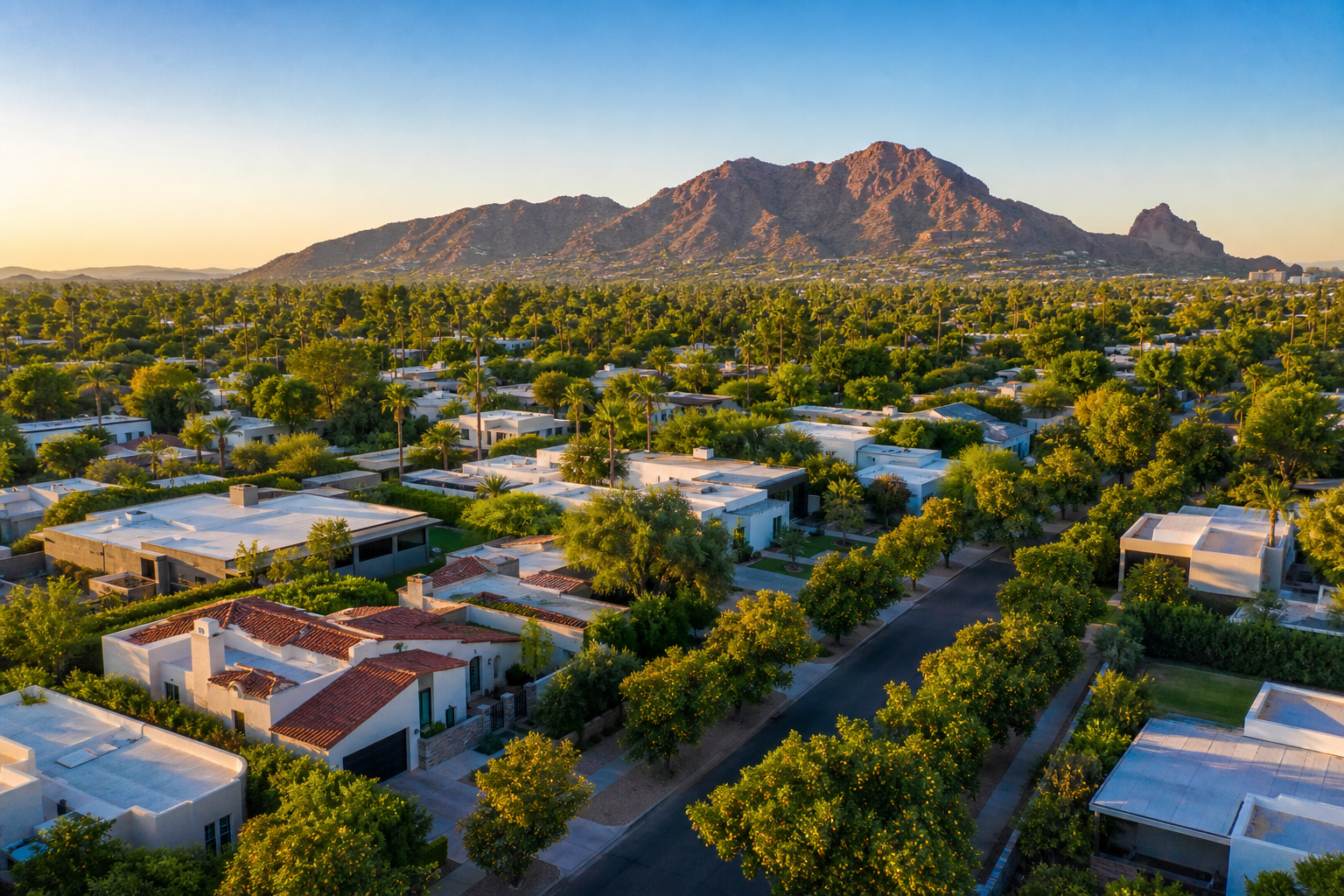
Living in Arcadia Phoenix puts you in one of the most sought-after neighborhoods in the entire Valley, and once you spend any time there it is not hard to understand why. Mature citrus trees lining the streets, views of Camelback Mountain from almost every block, walkable restaurants that actually have a scene, and a mix of housing that ranges from charming mid-century cottages to brand new custom builds pushing $4 million. Arcadia is one of those neighborhoods that people move into and never leave.
If you are considering a purchase in Arcadia, here is everything you need to know about the area, the market, and what life actually looks like on the ground.
A Little History on the Arcadia Neighborhood
Arcadia was originally agricultural land, developed in the early 20th century as orange and citrus groves supplied by the irrigation canals running through the area. The neighborhood sits between Phoenix and Scottsdale and was formally developed as a residential community through the mid-1900s. The citrus tree-lined streets that Arcadia is famous for today are a direct remnant of that agricultural past.
The area developed a reputation early as one of the most desirable addresses in the Valley, attracting professionals, business owners, and families who wanted proximity to the energy of central Phoenix and Scottsdale without being in the middle of either. That reputation has only grown. Today Arcadia is one of the most consistently competitive submarkets in greater Phoenix, with demand that holds up across market cycles better than almost anywhere else in the Valley.
The neighborhood spans roughly from 44th Street to 68th Street between Camelback Road and Indian School Road, though locals tend to think of it in a few distinct pockets. Arcadia Proper sits in the core of that footprint. Arcadia Lite refers to the area south of Thomas Road and tends to carry lower price points with the same general character. The area north of Camelback closer to the mountain is where the larger lots and higher price points concentrate.
Why Living in Arcadia Phoenix Is So Desirable
The location is the foundation of everything. Arcadia sits at the intersection of Phoenix and Scottsdale without fully belonging to either. You are 10 minutes from Old Town Scottsdale, 10 minutes from downtown Phoenix, and a short drive from the 51 and the 202. Sky Harbor Airport is close enough to be convenient without being close enough to hear the planes.
Camelback Mountain anchors the neighborhood visually and recreationally. Echo Canyon and the Cholla Trail are right there. Residents hike before work and are back home before most of the Valley has left the driveway. The canal paths that run through the area are some of the best urban walking and biking infrastructure in Phoenix.
The tree canopy is something you genuinely cannot manufacture. The citrus trees, the mature landscaping, the established lot sizes — these took decades to develop and cannot be replicated in a new master-planned community. That scarcity is a big part of what drives demand and protects values in Arcadia long term.
The restaurant and bar scene along Camelback and in the surrounding streets is legitimately one of the best in the Valley. This is not a neighborhood where you drive somewhere else to have a good time. The energy is right there.
The Restaurant and Bar Scene in Arcadia
This is one of the things that separates Arcadia from every other desirable Phoenix neighborhood. The food and drink scene here is walkable, unpretentious, and genuinely excellent.
The Porch on Camelback is a neighborhood staple. Good food, great patio, exactly the kind of place you end up at on a Tuesday without having planned it. The Vig has been an Arcadia anchor for years with a massive outdoor space that draws a crowd on weekends and somehow still feels like a locals spot. Postino is the wine bar that made the neighborhood famous for a casual night out and the bruschetta boards alone are worth the trip.
OHSO Brewery on the canal is one of the most unique spots in the Valley. Dog friendly, canal-facing patio, solid craft beer, and a crowd that reflects the neighborhood well. Chelsea’s Kitchen has a Southwestern menu and a patio that is hard to beat in the fall and winter months. La Grande Orange is part grocery, part cafe, part wine shop and has been a neighborhood institution for over a decade. Buck and Rider is where you go for oysters and seafood that would hold up in any coastal city.
The Henry is one of the best all-day spots in Arcadia. The interior is well-designed, the menu covers breakfast through dinner, and it has become a go-to for business lunches, weekend brunches, and everything in between. It is the kind of place that works for every occasion.
The concentration of quality within walking distance or a short bike ride is something Arcadia residents talk about constantly when explaining why they never want to leave.
The Arcadia Real Estate Market: What Your Budget Gets You
Arcadia covers a wide range of price points and housing styles, which is part of what makes it accessible to a broader buyer pool than most people realize.
At the entry level for the neighborhood, roughly $700,000 to $1 million, you are typically looking at original mid-century ranch homes on generous lots. Many of these have been updated over the years and offer solid square footage, mature landscaping, and the Arcadia address without the premium price of a newer build. For buyers who want to renovate or add their own finish level, this tier represents the best opportunity to build equity in a market that holds value well.
In the $1 million to $2 million range the options expand significantly. You will find extensively remodeled ranch homes with modern open floor plans and updated kitchens, as well as newer infill construction that has replaced older homes on desirable lots. Pool homes, larger lot sizes, and mountain views start showing up more consistently in this range. This is the most active and competitive segment of the Arcadia market.
Above $2 million you are typically looking at custom and semi-custom builds on larger lots, often with full outdoor living setups, high-end finishes throughout, and direct Camelback Mountain views. New construction in this tier from local custom builders and spec developers has been active in Arcadia for years as demand for turnkey luxury in the neighborhood continues to outpace supply. Homes in this range have sold north of $4 million in recent years and the upper end of the market shows no signs of softening.
One thing worth understanding about the Arcadia market is that it does not follow the broader Phoenix market as closely as other submarkets do. When the Valley softens, Arcadia tends to hold. When the Valley accelerates, Arcadia leads. The scarcity of lot supply and the consistent demand from high-income buyers and executives relocating to Phoenix keeps the floor elevated.
Arcadia Lite: The Entry Point Into the Neighborhood
Arcadia Lite is the section of the broader Arcadia area that sits south of Thomas Road, generally between 44th Street and 56th Street. It does not carry the full Arcadia address on paper but shares most of the same character, access to the same restaurants and canal paths, and proximity to the same amenities.
For buyers who want the Arcadia lifestyle at a more accessible price point, Arcadia Lite is worth serious consideration. Entry price points here start lower than Arcadia Proper and the neighborhood has seen significant renovation activity over the past decade as buyers priced out of Arcadia Proper moved south and brought investment with them.
The tradeoff is lot size, some street character differences, and the technical address. The upside is value, access, and a neighborhood that has been appreciating consistently as demand spills over from Arcadia Proper.
Schools and Practical Considerations
Arcadia falls within the Scottsdale Unified School District for much of its footprint, which is one of the higher-performing public school districts in Arizona. Arcadia High School serves the area and has a strong academic and athletic reputation. For buyers with school-age children, verifying the specific district boundary for any home you are considering is important, as the Phoenix and Scottsdale district lines run through parts of the neighborhood.
The neighborhood is walkable by Phoenix standards, extremely bikeable along the canal paths, and well-connected by major streets. Grocery options, medical facilities, fitness studios, and everyday services are all within a short drive. The area attracts a mix of young professionals, families, and established buyers, which gives it a demographic depth that keeps the neighborhood active across all stages of life.
Is Arcadia the Right Neighborhood for You
If you are considering living in Arcadia Phoenix and want to understand what the market looks like right now, what is available at your price point, and where the best opportunities are, I am happy to walk through it with you. Arcadia is one of my favorite submarkets in the Valley and I have worked with buyers across the full price range there.
You can also check out my full guide on the best neighborhoods in Scottsdale if you are comparing Arcadia against other high-demand areas nearby, read through my thoughts on whether now is a good time to buy a home in Phoenix, or review the questions to ask a real estate agent before making your decision.
Call or text me at (602) 935-6959, email Robbie@RJHHomesTeam.com, or visit rjhhomesteam.com.
Robbie Holycross is the founder of RJH Homes and has been working with buyers, sellers, and investors across the Valley for 6 years. He holds a background in finance and economics and carries an active mortgage license (NMLS 2633845), specializing in move-up buyers and real estate investors throughout the greater Phoenix metro.
Arcadia at a Glance: 2026
| Category | Detail |
|---|---|
| Location | Between Camelback Mountain and Papago Park |
| Median Home Price | ~$900,000-$1.2M |
| Lot Sizes | 8,000-20,000+ sq ft (some half-acre+) |
| Style | Mix of ranch homes, mid-century modern, custom builds |
| Walkability | High for Phoenix — near restaurants, shops, trails |
| School District | Scottsdale Unified (parts), Phoenix Union |
| Known For | Citrus trees, walkability, chef-driven restaurants |
Sources: Zillow Phoenix Home Values, Redfin Arcadia Market, City of Phoenix
Frequently Asked Questions About Arcadia Phoenix
Keep Reading
If you found this helpful, check out these related articles:
- Arizona Neighborhoods Before Buying
- Cost of Living in Phoenix AZ
- Moving to Phoenix Arizona: Relocation Guide
- Is Now a Good Time to Buy in Phoenix?
How much do homes cost in Arcadia Phoenix in 2026?
Homes in Arcadia Phoenix range from approximately $700,000 for smaller, un-updated ranch homes to well over $3 million for fully renovated or custom-built properties.
Homes in Arcadia Phoenix range from approximately $700,000 for smaller, un-updated ranch homes to well over $3 million for fully renovated or custom-built properties. The median sits around $900,000-$1.2M, making Arcadia one of the most premium neighborhoods in Phoenix. The wide price range exists because Arcadia has a mix of original 1950s-1960s ranch homes that need work and fully remodeled or newly built luxury properties. Location within Arcadia matters too — homes closer to Camelback Mountain or along the “Arcadia Lite” corridor south of Camelback tend to command higher prices.
What is the difference between Arcadia and Arcadia Lite?
Arcadia (sometimes called “Arcadia Proper”) sits north of Indian School Road between 44th Street and 56th Street, with larger lots, higher prices, and closer proximity to Camelback Mountain..
Arcadia (sometimes called “Arcadia Proper”) sits north of Indian School Road between 44th Street and 56th Street, with larger lots, higher prices, and closer proximity to Camelback Mountain. Arcadia Lite sits south of Indian School Road and offers a more accessible price point — typically $600K-$1M vs. $900K-$3M+ for Arcadia Proper. Both areas share the same walkable lifestyle, citrus tree character, and access to restaurants and shops along the Camelback corridor. First-time Arcadia buyers often start in Arcadia Lite and move north as their budget grows.
Is Arcadia Phoenix a good investment?
Arcadia is one of the strongest long-term real estate investments in Phoenix.
Arcadia is one of the strongest long-term real estate investments in Phoenix. The neighborhood’s limited geography, strict zoning that prevents high-density development, proximity to Camelback Mountain, and desirable lifestyle create persistent demand. Arcadia properties have historically appreciated faster than the Phoenix metro average, and they hold value better during downturns. The ongoing trend of buyers demolishing older ranch homes and building modern custom homes continues to push neighborhood values higher. Rental demand is also strong, particularly for short-term vacation rentals near the Camelback corridor.
What are the downsides of Arcadia Phoenix?
Key drawbacks include the high cost of entry ($700K+ for even a fixer-upper), many homes needing significant renovation (original 1950s-1960s plumbing, electrical, and roofing), flood zone considerations in some areas near the Arizona Canal, limited public parking near popular restaurants, and increased traffic as the area’s popularity has grown..
Key drawbacks include the high cost of entry ($700K+ for even a fixer-upper), many homes needing significant renovation (original 1950s-1960s plumbing, electrical, and roofing), flood zone considerations in some areas near the Arizona Canal, limited public parking near popular restaurants, and increased traffic as the area’s popularity has grown. HOA restrictions are minimal (most Arcadia homes are not in HOAs), which means some properties may have less exterior maintenance standards. Buyers should also budget for higher property insurance in flood-adjacent areas.
What makes Arcadia different from Scottsdale neighborhoods?
Arcadia offers a distinctly urban Phoenix lifestyle that’s different from Scottsdale’s suburban feel.
Arcadia offers a distinctly urban Phoenix lifestyle that’s different from Scottsdale’s suburban feel. Arcadia has larger lots with mature citrus trees, a more eclectic architectural mix, and walkable access to chef-driven restaurants and local shops — it feels like a neighborhood, not a master-planned community. Scottsdale offers more resort-style amenities, newer construction, golf communities, and mountain desert scenery. Arcadia appeals to buyers who want character, walkability, and proximity to central Phoenix. Scottsdale appeals to buyers who want newer homes, community amenities, and a suburban lifestyle. Price-wise, Arcadia’s cost per square foot is competitive with mid-tier Scottsdale communities like McCormick Ranch.