
Pool Maintenance in Arizona: What Every Homeowner Needs to Budget
Almost every buyer I take out here eventually says some version of the same thing: “We want a pool.” I get it. You moved to a place where it hits 110 degrees in June and the backyard pool is a big part of why you came. What almost nobody asks me before they write the offer is the follow-up question — what does that pool actually cost to own every month, and what does it cost the year the surface fails?
So let’s do the honest version. Below is what pool ownership really runs in the Phoenix metro in 2026: monthly service, chemicals, water, electricity, heating, the big-ticket repairs that show up on a schedule, and the insurance and safety pieces that people find out about after closing. I’ve pulled real 2026 pricing and cited the sources so you can check my math instead of taking my word for it.
The short answer: what pool maintenance costs in Arizona per month
If you hire a weekly service company and let them handle chemicals, budget $150 to $200 a month. Add water and electricity and a realistic all-in monthly number for a typical 14,000 to 20,000 gallon Valley pool is $200 to $300 a month — before you heat it, and before you set anything aside for repairs.
The number people get wrong is the second half. Pools don’t just cost money monthly. They cost money in lumps, every few years, on a fairly predictable timeline. If you only budget the monthly bill, the $9,000 resurface is going to feel like a disaster instead of a maintenance item.
Monthly pool maintenance costs, broken down
Statewide crowdsourced 2026 service pricing puts the Arizona average at about $151 a month with chemicals included, median $150, with the Phoenix metro running slightly higher at roughly $152 to $157 a month. Angi’s Phoenix data shows a wider band — $100 to $376 — because it mixes weekly full-service with light biweekly plans.
| Line item | Typical monthly cost (2026) | Notes / source |
|---|---|---|
| Weekly pool service, chemicals included | $150–$170 | AZ average $151–$152/mo; Phoenix metro avg $156.67 with chems (PoolDial 2026 AZ rate survey) |
| DIY chemicals only (no service) | $40–$80 | Chlorine/acid/salt; higher in summer when demand spikes |
| Electricity — variable-speed pump | $15–$35 | Single-speed pumps run $350–$750/yr in electricity at 2026 APS/SRP rates (2026 pump rebate analysis) |
| Water for evaporation / backwash | $15–$40 | Phoenix volume rates peak June–September (City of Phoenix water & sewer rates) |
| Repair reserve (recommended) | $60–$100 | My own rule of thumb — see the replacement schedule below |
| Realistic all-in, unheated | $200–$300 | More if you heat, more if you have water features or an attached spa |
Two things drive your number to the top of those ranges. First, monsoon season. Dust storms dump a summer’s worth of grit into the water in twenty minutes, and every one of those events costs you chemicals, filter cleanings, and sometimes a service call. Second, our water. Valley tap water is hard, so scale on the tile line and the surface is constant, and pools here need more acid and more brushing than the same pool would in a soft-water market.
The lumps: equipment lifespan and replacement costs
This is the table I wish every buyer saw before they toured a house with a twenty-year-old pool. Arizona sun and hard water shorten the life of basically everything on the equipment pad, and there’s no version of pool ownership where these items don’t come due.
| Item | Typical Arizona lifespan | Replacement cost (2026) |
|---|---|---|
| Plaster surface | 10–15 years (some sources say 7–12) | $6,000–$10,000 resurface (Phoenix resurfacing pricing, 2026) |
| Pebble finish (Pebble Tec / Pebble Sheen) | 15–25 years | $9,000–$16,000 resurface |
| Pump (variable-speed) | 8–12 years | $1,200–$2,200 installed, minus a $100 SRP or $150 APS instant rebate |
| Filter cartridges / DE grids | 2–5 years | $150–$500 |
| Salt cell (saltwater systems) | 3–7 years | $250–$800 (Angi Phoenix pool maintenance data) |
| Heater — gas | 5–10 years | $2,000–$4,000 installed |
| Heater — heat pump | 10–15 years | $3,500–$7,000 installed (Shasta Pools, Phoenix heat pump costs) |
| Drain, acid wash & refill | Every 3–5 years, as needed | $350–$600 basic; $1,200–$2,000+ if it needs full recovery |
Annualize it. A plaster pool with a gas heater carries roughly $900 to $1,400 a year in eventual replacement cost even in years when nothing breaks. That’s the $60 to $100 a month reserve line in the first table, and it’s the line almost every new pool owner skips.
Pebble vs plaster: the math on a 20-year horizon
Plaster is cheaper per square foot — roughly $4 to $6 versus $8 to $12 for Pebble Tec — and it’s smoother underfoot. But in Arizona conditions, plaster wants to be redone in 10 to 15 years and pebble goes 15 to 25. Over twenty years, two plaster resurfaces usually cost as much as or more than one good pebble job, and you’ve lived with a failing surface twice instead of once.
My take: if you’re staying five years or less, resurface in plaster and don’t overthink it. If this is the house you plan to be in for fifteen years, pebble is the better financial decision and it holds up far better to our UV and hard water. And if you’re selling, understand that a chalky, stained, patched surface is one of the fastest ways to invite a repair credit — the same principle I cover in how to increase your home value in Arizona before selling.
Heating a pool in Phoenix: the bill nobody predicts
Yes, our water gets cold. From roughly November through March an unheated Valley pool sits in the 50s and 60s, and plenty of people who bought a pool for year-round swimming discover they own a very large decorative water feature for four months.
The single biggest variable in heating cost is not the equipment — it’s whether you use a cover. The Department of Energy’s Phoenix estimate to hold a pool at 82°F from March through October is about $1,485 per season with no cover versus $158 with one, at $0.1301/kWh. Scale that up to Arizona’s more recent average residential rate near $0.1576/kWh and you’re looking at roughly $1,800 uncovered versus about $190 covered for the same season.
| Heating scenario | Cost to run | Best for |
|---|---|---|
| Heat pump, covered, shoulder months | ~$95–$140/month | Steady everyday heating October–May |
| Heat pump, frequent use (3–5 swim days/week) | $50–$100/month, $450–$900/season | Most Valley families |
| Gas heater, weekend use | $300–$500/month | Spa nights, quick temperature boosts |
| Gas heater, year-round 84–88°F | $400–$700/month, $4,800–$8,400/year | Almost nobody, honestly |
| No heater, no cover | $0 | Swimming roughly April–October |
Sources: Shasta Pools’ Phoenix heat pump analysis and a 2026 heat pump vs gas comparison. If you want to swim in January, a heat pump plus a cover is the answer. A gas heater used daily is how you get a utility bill that makes you stop swimming.
Green pools, monsoons, and dust storms
A pool goes green here faster than people expect. Water in the high 80s, blowing organic debris, and one skipped week of chemistry is all it takes — which is why the worst green pools I see happen in July and August, and why they cluster around vacations.
Recovery pricing in the Valley in 2026 runs roughly $250 to $400 for a light bloom, $400 to $700 for moderate, $700 to $1,200+ for severe, and $1,200 to $2,000+ when it’s a total loss requiring a drain, acid wash, and refill, according to Valley algae-recovery pricing and Phoenix drain-and-acid-wash quotes in the $350 to $600 range.
Practical habits that save real money here: run the pump on a variable-speed schedule instead of a short high-speed burst, brush the walls weekly, clean the filter after every big dust event instead of on a calendar, and never leave the pool unattended for two weeks in summer without paying someone to look at it. Also, if you refill after a drain, do it in January, February, or March when Phoenix water rates are lowest, and request a sewer fee review through the city so you aren’t billed sewer charges on water that went into your pool.
Insurance and Arizona’s pool barrier law
Two things a pool changes on the paperwork side. First, insurance. Insurers treat a pool as an “attractive nuisance,” and Arizona homeowners typically see about $50 to $75 a year more in premium after adding one — small. The bigger deal is the liability limit. Standard $100,000 liability is not enough for a pool household; $300,000 to $500,000, or an umbrella policy, is the standard recommendation (insurance and pools).
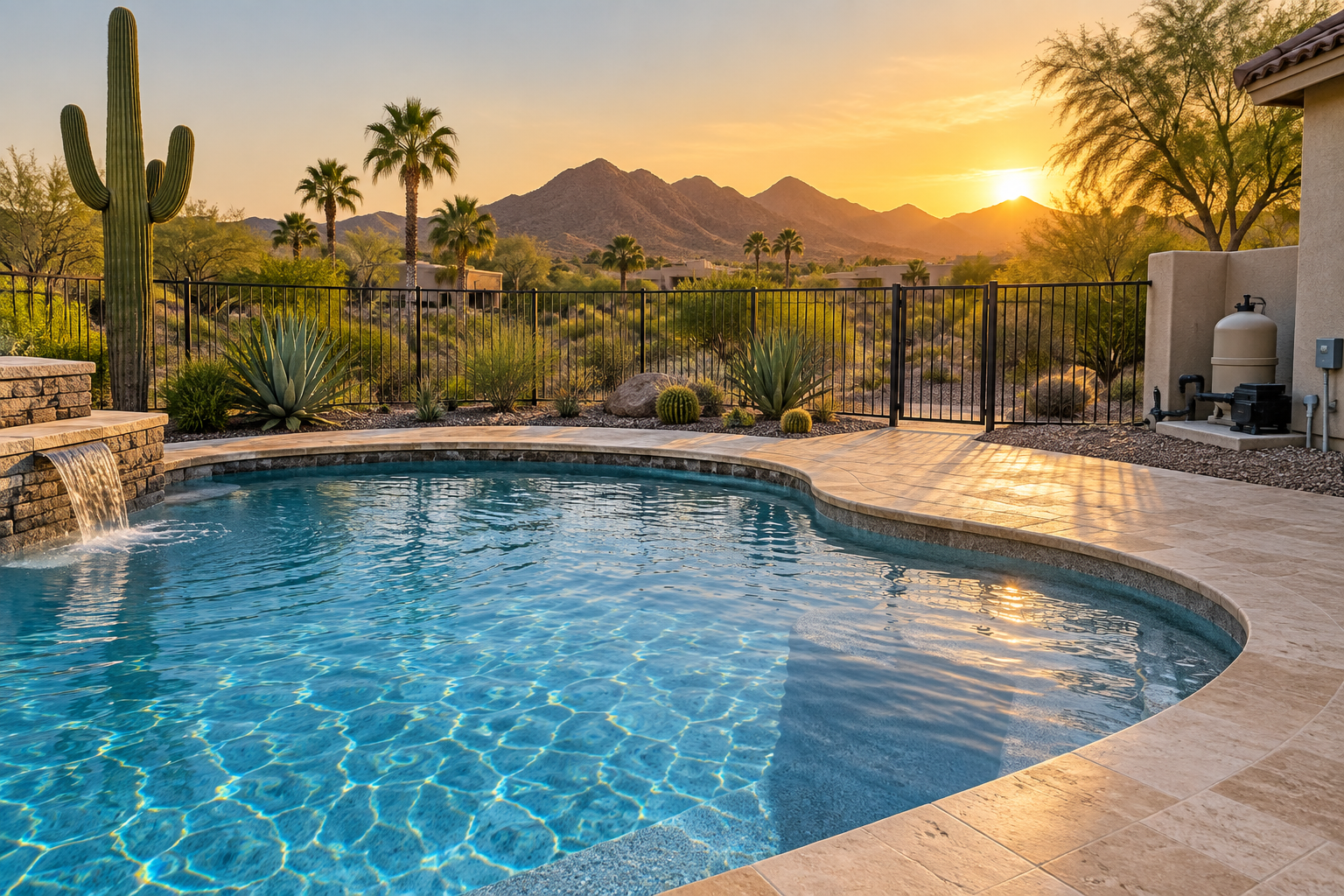
Second, the barrier law. Under A.R.S. § 36-1681, pools deeper than 18 inches at homes with a resident under six generally require an enclosure at least five feet high, and gates must open outward from the pool and be self-closing and self-latching with the latch at least 54 inches above the ground (or on the pool side with a specific release configuration). Cities and HOAs layer their own requirements on top. If you’re buying a pool home, check the barrier during inspection — retrofitting a compliant fence and gate is a real line item, not a formality. This is the kind of thing I flag in what the desert does to your house during an Arizona home inspection.
Does a pool actually add value in the Valley?
Usually yes, modestly, and never dollar-for-dollar with what it cost to build. Nationally an in-ground pool adds roughly 5% to 8% to value, and in Sun Belt markets like ours the premium can reach 10% or more, per Opendoor’s analysis of pool value. But appraisers assign contributory value — what buyers in your specific subdivision have actually paid for pool homes versus non-pool homes — not construction cost.
Which means: a clean, well-equipped pool with a healthy surface helps you. A neglected one hurts you, often by more than a good pool would have helped, because buyers mentally deduct a resurface plus a new pump the moment they see chalky plaster and 2009 equipment. And every pool trims your buyer pool slightly — some families rule out pool homes entirely over safety and upkeep. If you’re weighing whether to build one before listing, don’t. Building a $60,000 pool to recover maybe $25,000 at resale is one of the clearest money-losing pre-sale projects in this market. Get a real comparison of pool and non-pool sales in your subdivision first — that’s what a CMA versus an appraisal is for.
How I’d budget it if I were buying a pool home tomorrow
- $250/month operating — service with chemicals, water, electricity on a variable-speed pump.
- $100/month reserve — this is the resurface, the pump, the salt cell, the heater. Put it in a separate account and it stops being an emergency.
- $100/month heating budget, seasonal — only if you want to swim November through March, and only with a cover.
- One-time at purchase: a dedicated pool inspection (separate from the home inspection, usually $150–$350), plus whatever the barrier and gate need to be compliant.
Roughly $350 a month all-in, $450 if you heat. That’s the honest number. It’s not scary if you plan for it, and it’s genuinely worth it for a lot of families — a pool in Phoenix gets used eight or nine months a year, which is not true in most of the country. It’s just not free, and the listing photos never mention that. If you want more of the costs that don’t show up on the settlement statement, I wrote about them in hidden costs of buying a home in Arizona.
Talk to me before you buy the pool house
When I walk a pool home with a client, I’m looking at the surface, the tile line, the date codes on the equipment, the deck cracks, and the gate latch. Those five things tell me whether we’re negotiating for a $500 clean-up or a $12,000 project, and that changes what we offer. If you’re shopping for a home with a pool anywhere in Maricopa County — or you own one and you’re trying to figure out what to fix before you list — reach out and let’s go through the numbers on your specific property.
Frequently Asked Questions
How much does pool maintenance cost per month in Arizona?
Weekly professional pool service with chemicals runs $150 to $170 a month in the Phoenix metro in 2026, and a realistic all-in monthly cost including water and electricity is $200 to $300 for an unheated pool. Statewide Arizona service averages about $151 per month with chemicals, with Phoenix metro slightly higher. Add roughly $60 to $100 a month as a reserve for resurfacing and equipment replacement, and $50 to $150 a month if you heat the pool.
How often does an Arizona pool need to be resurfaced and what does it cost?
Standard plaster lasts 10 to 15 years in Arizona and costs $6,000 to $10,000 to resurface; a pebble finish lasts 15 to 25 years and runs $9,000 to $16,000. Our intense UV and hard water are hard on pool surfaces, so plaster here fails faster than in milder climates. Over a 20-year horizon, two plaster resurfaces often cost as much as one quality pebble finish, which is why long-term owners usually come out ahead choosing pebble.
What does it cost to heat a pool in Phoenix?
A heat pump with a pool cover runs roughly $50 to $140 a month, while a gas heater used daily can run $400 to $700 a month. The Department of Energy estimates holding a Phoenix pool at 82 degrees from March through October costs about $1,485 per season without a cover versus $158 with one; at Arizona’s recent average electric rate that scales to roughly $1,800 versus $190. A cover is the single highest-return purchase for any heated pool in the Valley.
How much does it cost to fix a green pool in Phoenix?
Green pool recovery in the Phoenix area costs about $250 to $400 for a light algae bloom, $400 to $700 for a moderate bloom, and $1,200 to $2,000 or more if the pool must be drained, acid washed, and refilled. Pools turn green fastest in July and August when water temperatures are high and monsoon storms blow organic debris in. A basic drain and acid wash alone typically runs $350 to $600 in Phoenix.
Does a pool add value to a home in the Phoenix metro?
Yes, modestly — an in-ground pool typically adds 5% to 8% to home value nationally and can reach 10% or more in hot-climate Sun Belt markets like Phoenix, but never dollar-for-dollar with construction cost. Appraisers assign contributory value based on what buyers actually paid for comparable pool versus non-pool homes in your subdivision. A neglected pool with a failing surface and dated equipment can reduce value, and building a pool purely to sell almost never pays back what it cost.